Heat pump basics · Heat exchangers
Heat exchanger knowledge guide
Heat exchangers set temperature approach, pressure drop, and much of the oil-return story. “Plate vs shell-and-tube” is not a slogan—it is a match of duty, fluids, and maintainability. This illustrated guide covers families, flow and transfer intuition, how to read a duty point, reliability risks, and heat-pump / HTHP specifics. Pair with the compressor and valve guides; OEM tools sit under Tools & Standards.
1 · Role in the vapor-compression cycle
Compressors create pressure; exchangers move the heat. Evaporators absorb, condensers (or gas coolers) reject—and optional IHX / economizers reshape the cycle between them.
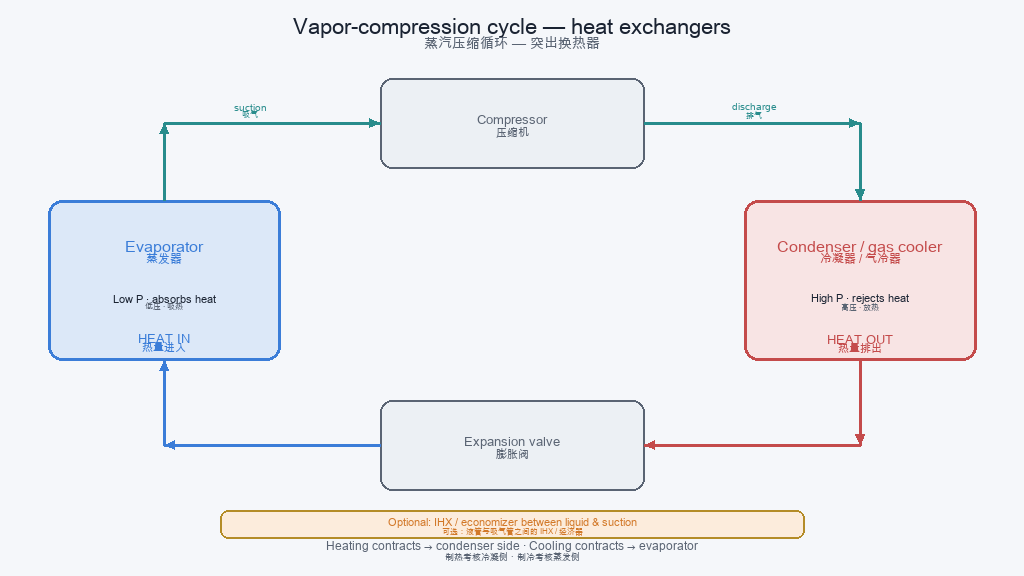
Evaporator · condenser · gas cooler
At subcritical pressures the condenser rejects latent heat. Transcritical CO₂ often uses a gas cooler instead—same job, different thermodynamics. Always name which side is the contract metric.
Approach temperature drives COP
Tighter approach lowers the lift the compressor must provide—but raises UA, cost, and often pressure drop. There is no free “closer is always better.”
IHX / economizer as helpers
Internal heat exchangers and economizers trade suction superheat against liquid subcooling or intermediate injection. They are cycle options, not a substitute for correct evaporator/condenser sizing.
2 · Structural families
No single construction wins every band of capacity, fluid pair, and service access. Filter by family, then confirm with OEM software at your temperatures and flows.
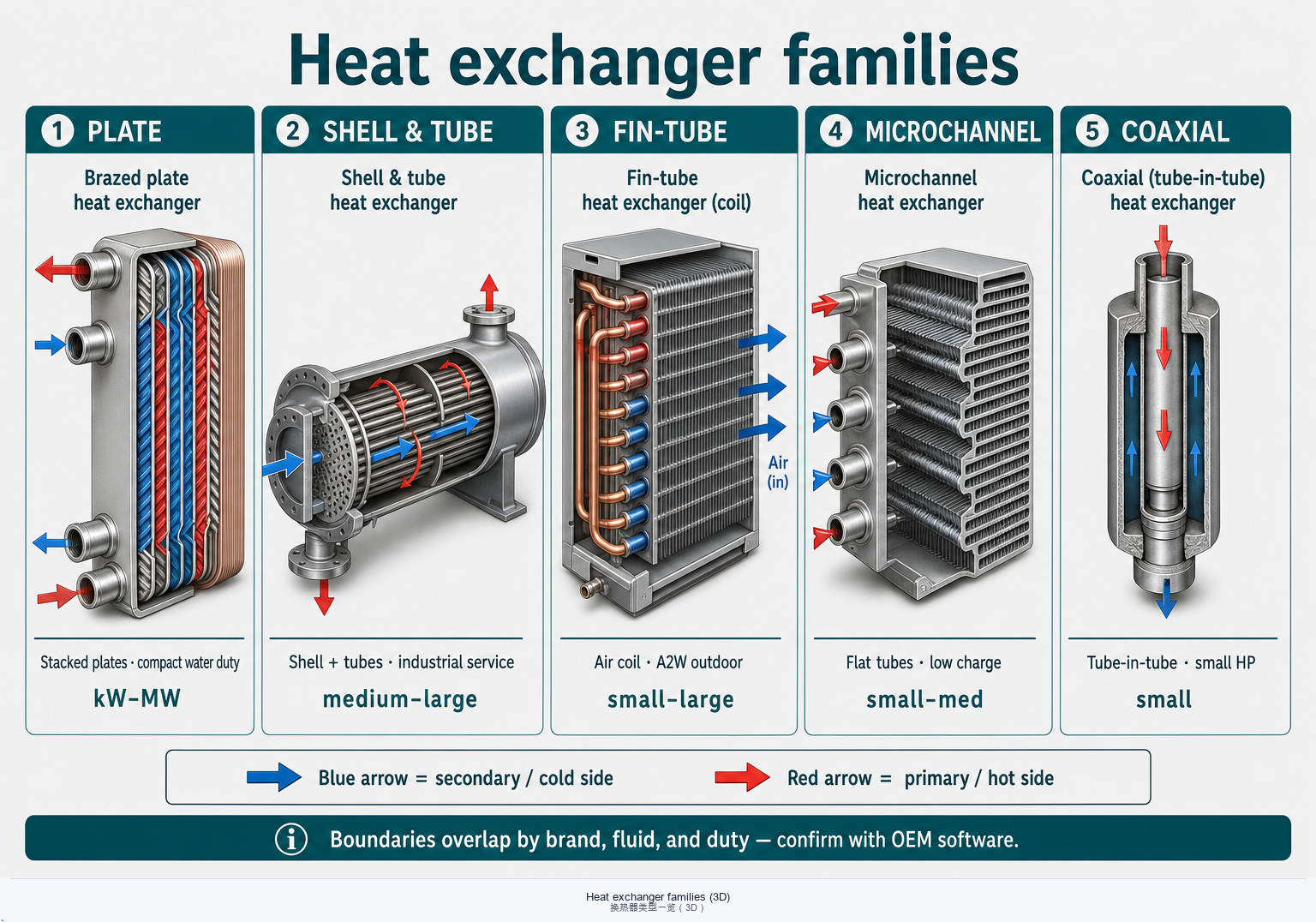
| Family | Typical capacity band | Typical media | ΔP / cleanability | Heat-pump intuition |
|---|---|---|---|---|
| Plate (brazed / gasketed) | Small–large (kW to MW-class stacks) | Refrigerant–water / brine; liquid–liquid | Compact; gasketed can open; brazed hard to clean | Dominant water-side HX in packaged HP |
| Shell & tube | Medium–large | Refrigerant–water; process fluids | Serviceable tubes; flooded / DX variants | Industrial chillers & many HTHP sinks |
| Fin-tube (air coil) | Small–large | Refrigerant–air | Air ΔP & frost dominate O&M | Outdoor / indoor coils on A2A & A2W |
| Microchannel | Small–medium | Refrigerant–air; low charge | Low charge; repair & fouling differ from Cu/Al | Charge-sensitive A2L / R290 platforms |
| Coaxial / tube-in-tube | Small | Refrigerant–water | Simple; limited service access | Compact water HP / specialty packs |
Flooded and falling-film shells are industrial variants of shell-and-tube—select for oil return and liquid level control, not brochure kW alone.
3 · Flow arrangement and heat transfer
Counterflow, crossflow, and parallel flow change the LMTD you can achieve for the same end temperatures. Approach and UA are the practical language of sizing meetings.
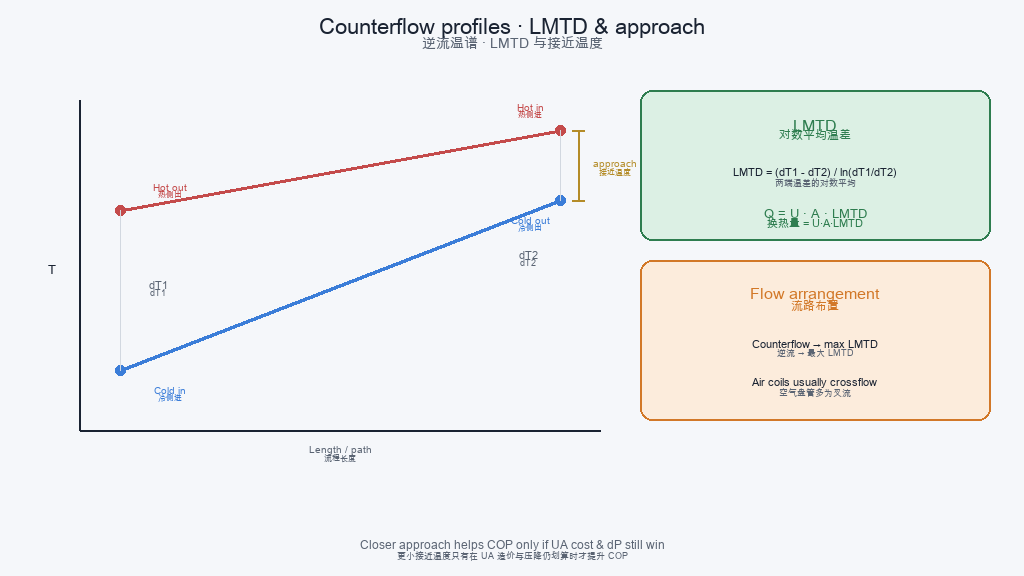
Counterflow vs crossflow
Counterflow maximizes LMTD for given inlet/outlet temperatures. Air coils are usually crossflow; water plates often approximate counterflow in multipass designs.
Approach temperature
Approach is the gap between a refrigerant saturation (or exit) temperature and the secondary fluid. Spec it explicitly—marketing “kW” often hides a generous approach.
UA / NTU intuition
UA is the size knob; NTU relates UA to capacity rate. Useful for orientation—final selection still needs fluid properties, fouling factors, and OEM correlation.
Primary vs secondary
Name both sides: refrigerant grade, oil presence, water/brine chemistry, air humidity. Corrosion and freeze risk live on the secondary side more often than sales slides admit.
4 · How to read performance / duty data
A catalog kilowatt is a point on a surface of inlet temperatures, flows, and fouling assumptions—not a portable sticker.
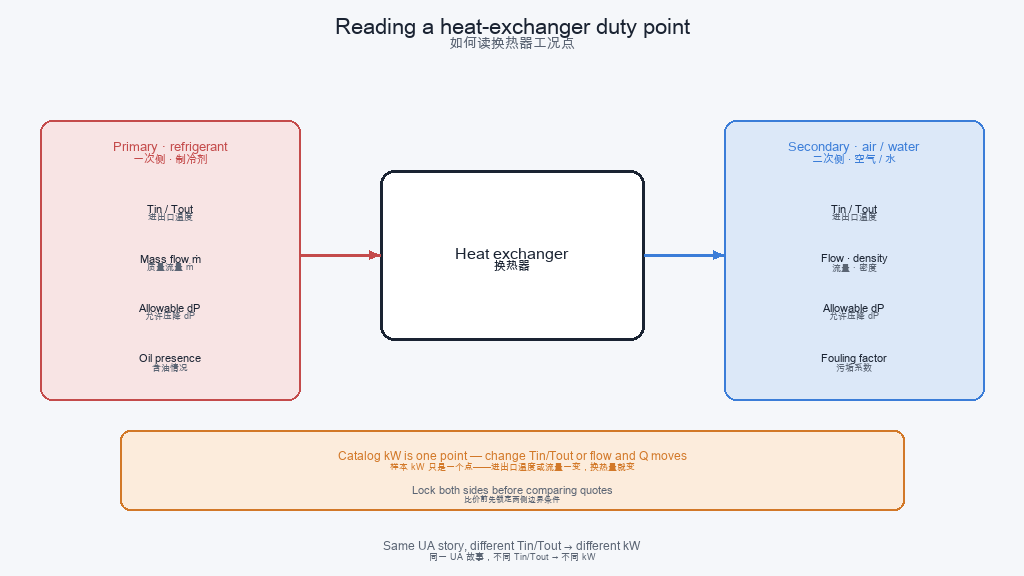
Duty ≠ nameplate
Change inlet temperatures or flow and Q moves. If the quote omits secondary conditions, you are not yet comparing the same exchanger.
Pressure drop in the budget
Water ΔP hits pump power; air ΔP hits fan power and frost behavior. “More plates / denser fins” can steal seasonal COP even when peak kW looks fine.
Fouling factor & standards
Ask which fouling factor and which rating standard sit behind the number. Align with the same boundary used for the compressor map and expansion control.
One-sentence memory
Same UA story, different Tin/Tout → different kW. Approach and ΔP belong in the contract language.
5 · Fouling, frost, oil, and freeze
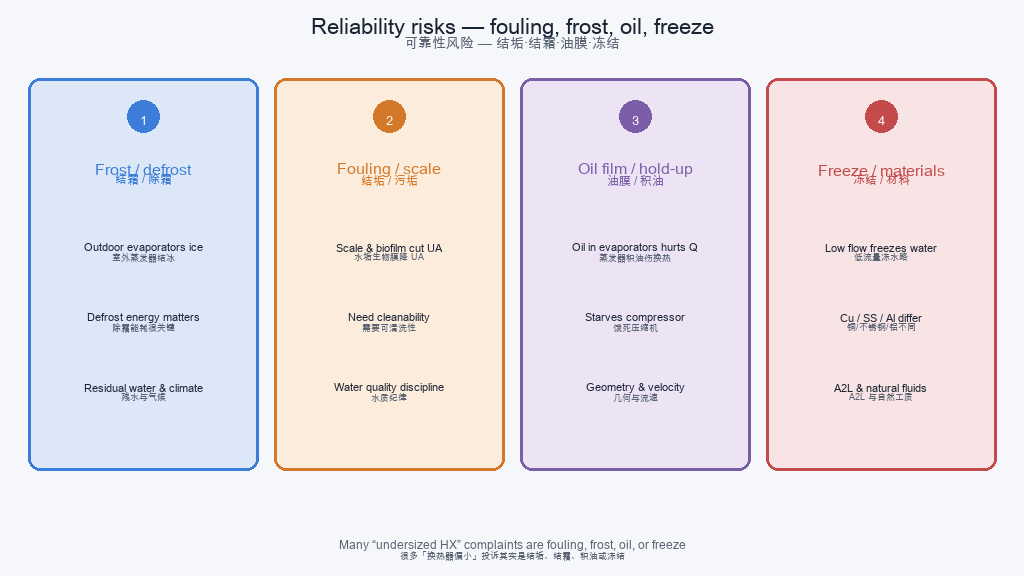
Many “undersized HX” complaints are fouling, frost, oil film, or freeze protection—not a missing square metre of surface.
Air-side frost
Outdoor evaporators ice when surface temperature and humidity allow. Defrost energy and residual water matter as much as peak capacity tables.
Water-side fouling
Scale and biofilm cut UA. Gasketed plates and shell-and-tube win when cleaning is inevitable; sealed brazed packs need water quality discipline.
Oil film & hold-up
Oil stranded in evaporators hurts heat transfer and starves the compressor. Geometry and velocity are part of HX selection—see also the compressor oil chapter.
Freeze & materials
Low flow or control failure can freeze water circuits. Copper, stainless, and aluminum bring different corrosion and repair stories—especially with A2L / natural fluids.
6 · Heat-pump and high-temperature specifics
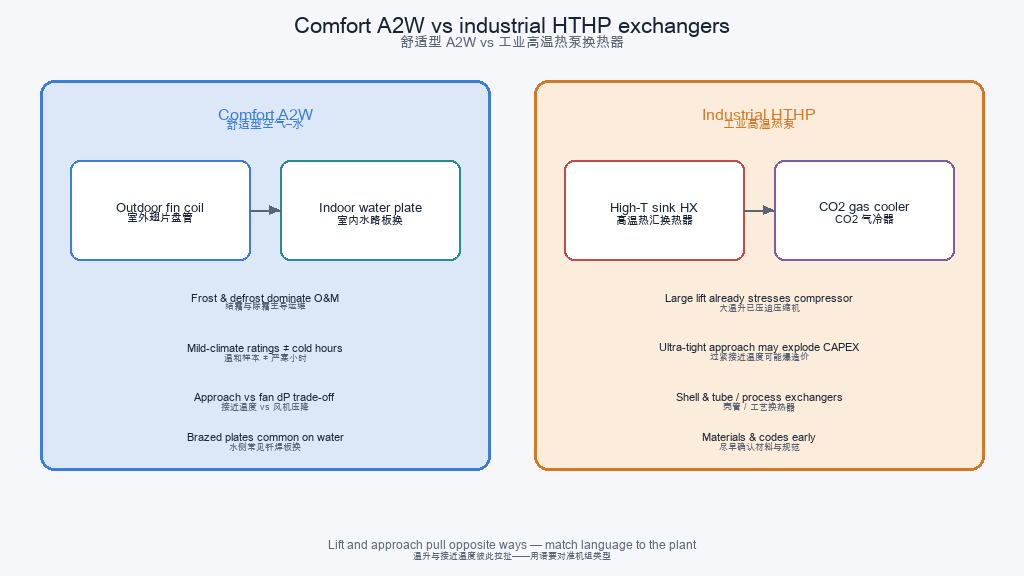
Large lift and tight approach pull in opposite directions. Comfort A2W and industrial HTHP need different exchanger languages.
Lift vs approach
High sink temperature already stresses the compressor. Demanding an ultra-small approach on the condenser can explode CAPEX without proportional COP gain.
Water-water vs air-source
Water-water plates avoid frost but inherit fouling and freeze risk. Air-source coils inherit climate and defrost—size for the coldest credible hours, not only mild ratings.
CO₂ gas coolers
Transcritical rejection is sensitive to gas-cooler exit temperature. Ambient and approach design dominate seasonal performance—pair with the refrigerant guide.
Process / HTHP sinks
Shell-and-tube and specialized process exchangers appear when temperatures, pressures, or chemistries leave comfort plates behind. Confirm materials and codes early.
7 · Selection checklist
Before comparing price per kW, lock both fluid sides and the maintainability story.
- Fluids & corrosion: refrigerant (and oil), water/brine chemistry, air contaminants.
- Design temperatures: Tin/Tout or approach on both sides at design and a realistic off-design point.
- ΔP budget: pump/fan power and minimum flow for freeze / oil return.
- Maintainability: cleanable vs sealed; spare plates/tubes; freeze protection.
- Rating boundary: same standard and fouling factor as the contract / compressor map.
- System match: compressor envelope and expansion / reversing valves sized for the same duty.
Still stuck on mismatched “元/kW”? See fundamentals · pricing & standards.
8 · Quick FAQs
“Can a plate always replace a shell-and-tube?”
Only when fluids, pressure, fouling, and service access allow. Many industrial sinks still need shells for cleanability, flooded control, or extreme temperatures.
“Is a smaller approach always better?”
Not if UA cost and ΔP erase the COP gain. Spec approach as an economic choice, not a moral absolute.
“Why doesn’t catalog kW match the field?”
Different Tin/Tout, flow, fouling, or frost. Re-run OEM software at measured conditions before condemning the hardware.
“Where next on this site?”
OEM correlations, fouling factors, and standard editions vary by product and year. This page is engineering orientation for buyers and integrators—not a substitute for signed data sheets, type tests, or code compliance.