Heat pump basics · Lubricants
Lubricant knowledge guide
Oil is not “something in the compressor sump”—it is a system fluid that lubricates bearings, seals gaps, and travels with refrigerant. Wrong viscosity, miscibility, or moisture control fails as seizure and fouling, not as a quiet oil-label mistake. Pair with the compressor oil chapter and oil separator guide; this page focuses on oil chemistry and selection.
1 · Role in the heat-pump system
Bearings need a film; rotors and pistons need cooling and sealing; evaporators need oil to leave again. Treat oil as part of the mass-flow story.
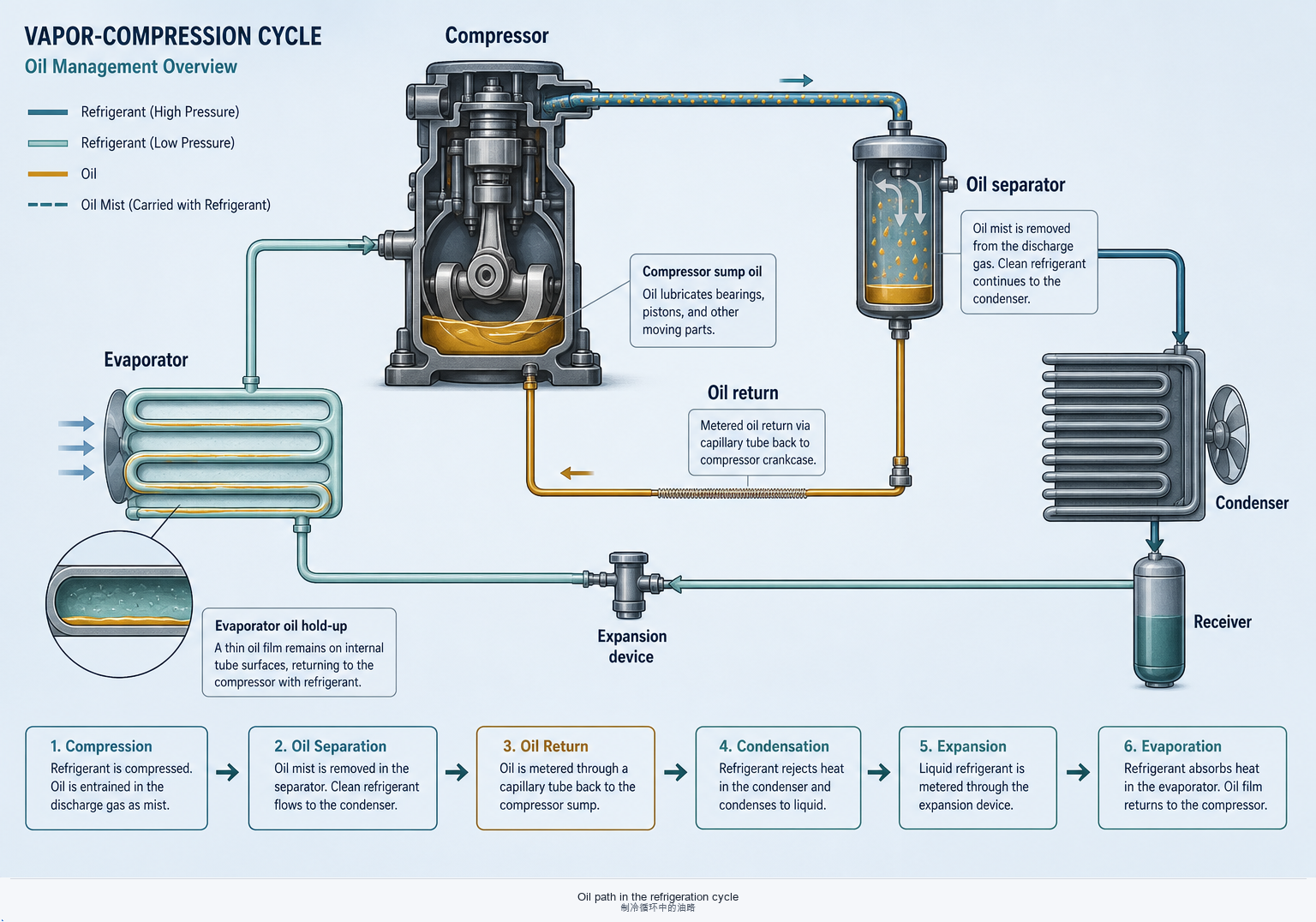
Lubrication & sealing
A hydrodynamic film protects bearings and sliding surfaces. Oil also reduces blow-by in clearances. Too thin at high discharge temperature → metal contact; too thick at cold start → starved ports and high torque.
Carrier with refrigerant
Discharge mist carries oil into the circuit. Separators reclaim most of it; residual oil must return from evaporators and headers. See oil separators and oil return.
Heat-transfer side effect
Oil films on heat-exchanger surfaces cut capacity and raise approach temperature. “More oil is safer” is false when the evaporator becomes an oil trap.
2 · Oil families and refrigerant pairing
Mineral and synthetic families are not interchangeable stickers. Match chemistry to refrigerant, then confirm the OEM qualified list.
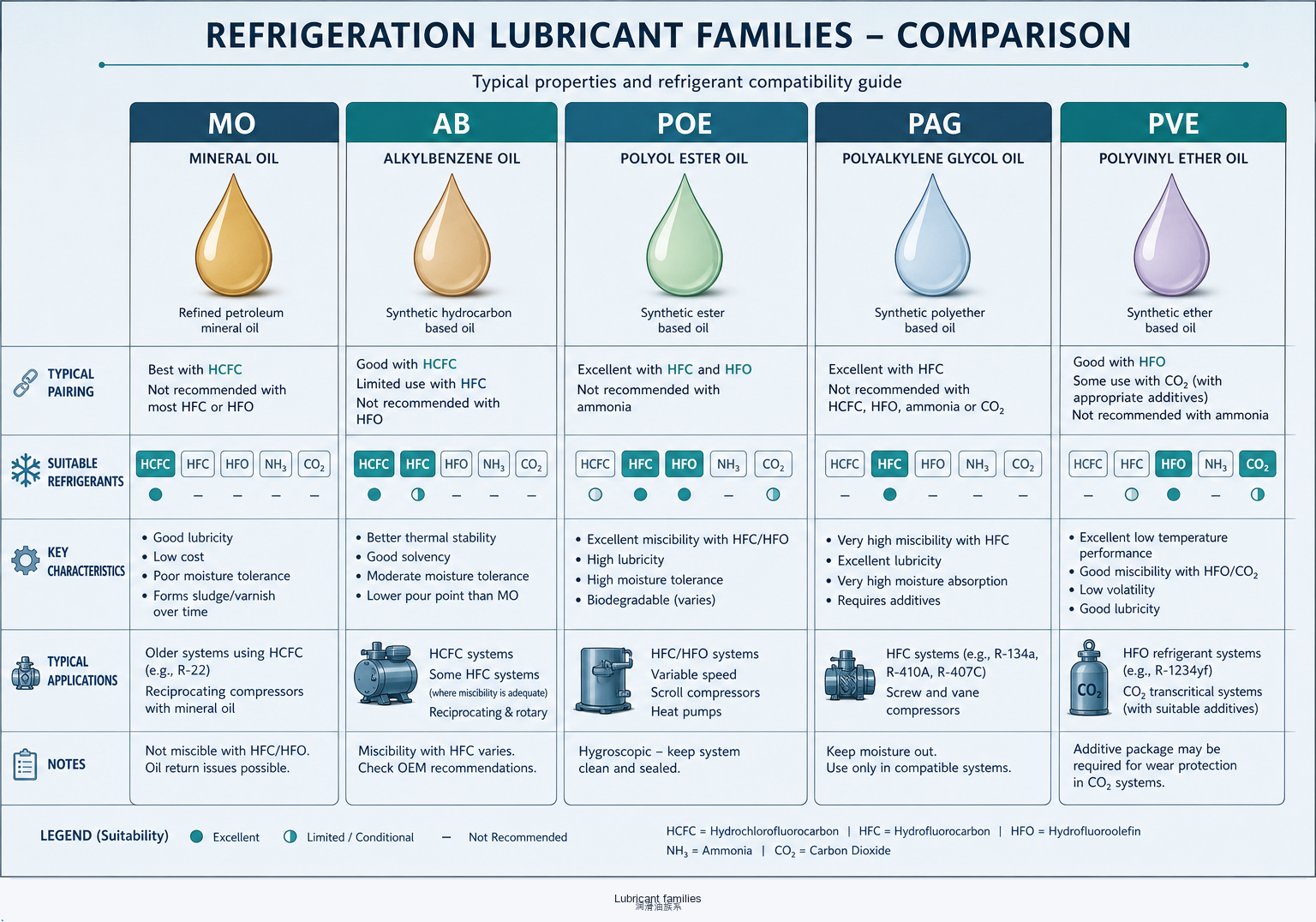
| Family | Full name | Typical fluids | Engineering notes |
|---|---|---|---|
| MO | Mineral oil | Legacy HCFC / some HC | Low hygroscopicity; poor with many HFCs |
| AB | Alkylbenzene | HCFC / some retrofit paths | Better solvency than MO in selected duties |
| POE | Polyolester | HFC / HFO / many HP packs | Hygroscopic—moisture & acid control critical |
| PAG | Polyalkylene glycol | Auto A/C; some CO₂ / specialty | Miscibility windows differ from POE—do not swap casually |
| PVE | Polyvinyl ether | Selected HFC / HFO OEM lines | Often less hygroscopic than POE; follow OEM only |
Ammonia (R717) and hydrocarbon systems use specialized oils—never assume a fluorocarbon POE applies. CO₂ packs need OEM-qualified grades for pressure and miscibility.
3 · Viscosity, miscibility, moisture, and acid
Catalog ISO VG numbers are a start. Dilution with refrigerant and temperature swing define the real film at the bearing.
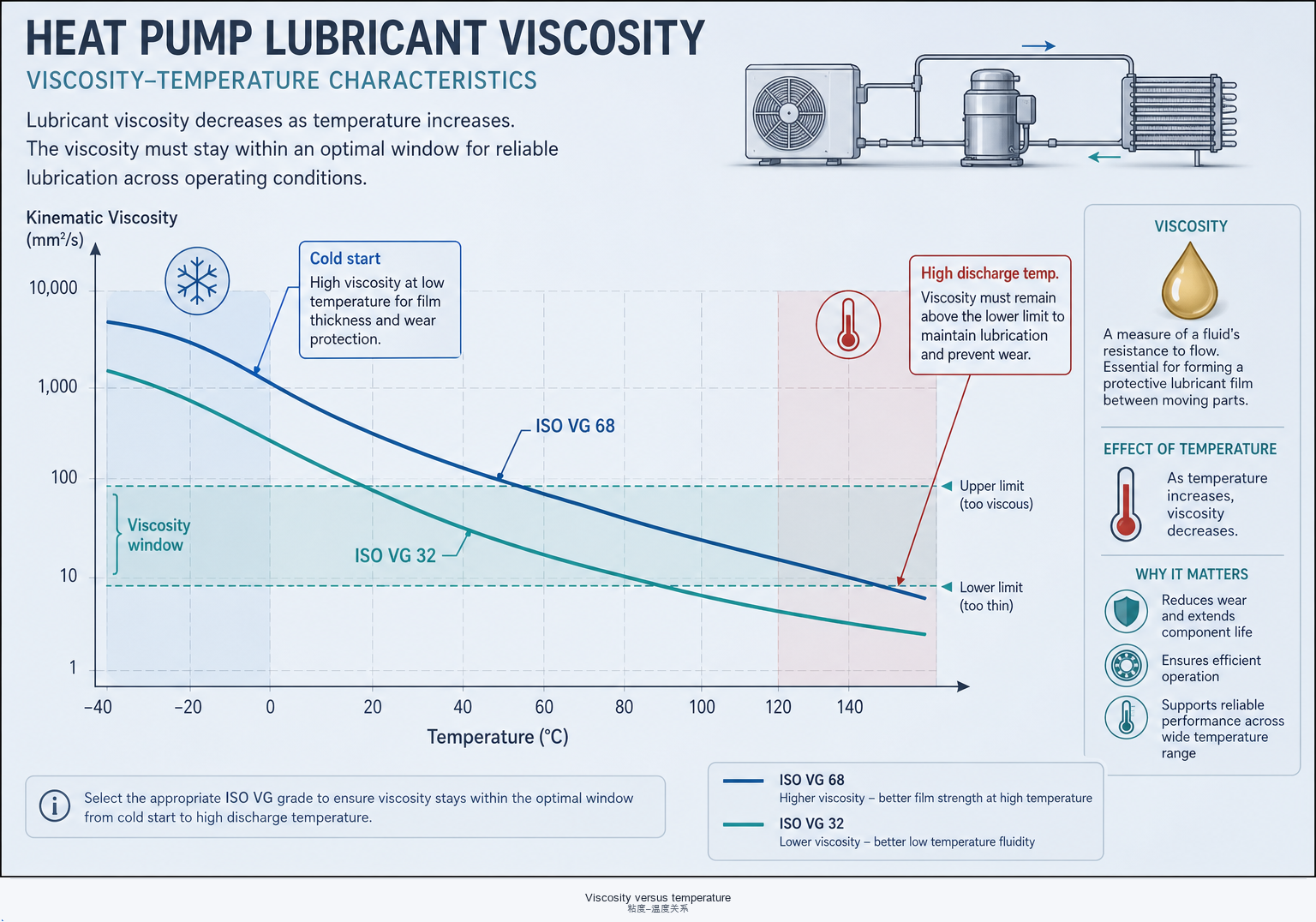
Viscosity grade
Pick a grade that stays inside the OEM viscosity window at suction and discharge extremes—not only at 40 °C catalog test temperature. High-lift heat pumps stress the hot end.
Miscibility & return
Oil that separates and pools in cold evaporators will not return. Miscibility maps vs temperature and oil concentration decide whether part-load return is credible.
Hygroscopicity
POE oils grab moisture from air during open handling. Water + heat → hydrolysis and acid → copper plating and bearing damage. Keep drums sealed; use dry nitrogen practice per OEM.
Acid number & TAN watch
Rising acid number after a burnout or chronic moisture is a system health metric. Flush and oil-change procedures belong in the service plan—not only “top up.”
4 · Charge, oil change, and contamination control
Factory charge assumes a clean, dry circuit. Field top-ups and “compatible” substitutes are where reliability bets go wrong.
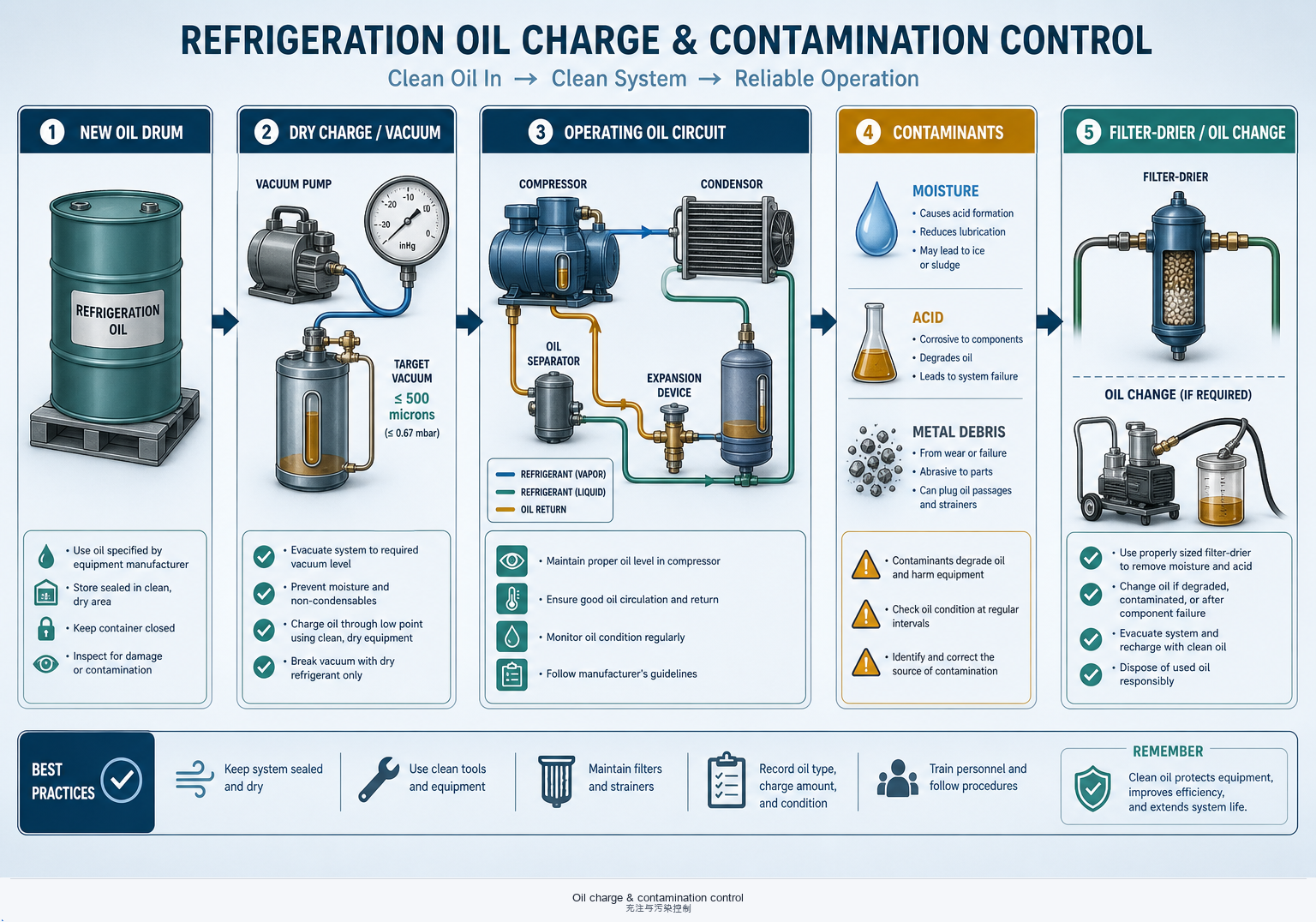
Initial charge
Use OEM-specified oil type and mass. Excess oil raises carry-over and fouling; deficit starves bearings. Screw packs may list separate circuit oil volumes.
Mixing & retrofit
Mixing mineral and POE (or PAG and POE) without a documented flush path can create sludge. Retrofit refrigerants often require oil change—follow the fluid supplier and compressor OEM jointly.
Burnout & debris
Motor burnout contaminates oil with acid and conductive debris. Cleanup is a system job: filters, driers, possibly multiple oil changes—not a compressor swap alone.
One-sentence memory
Oil approval is a refrigerant + compressor pair—not a generic “VG 68 for heat pumps” rule of thumb.
5 · Selection checklist
Lock fluid and compressor first; oil is the third column on the same engineering sheet.
- Refrigerant (and blend) locked—then open the OEM oil approval list.
- Viscosity grade inside the map at design Te/Tc and at a hot high-lift corner.
- Miscibility / return credible at minimum continuous mass flow (inverter low speed).
- Moisture & handling: sealed packaging, dry tools, POE open-time limits.
- Separator & piping designed with the oil story—see vessels and piping.
- Service plan: oil sample / acid check after incidents; no casual “compatible” substitutes.
Need the machine-side oil-return geometry? Continue at Compressor · Oil & reliability.
6 · Quick FAQs
“Can I swap POE brands if the ISO VG matches?”
Not safely by VG alone. Additive packages and OEM approvals differ. Stick to the compressor maker’s listed oils for that refrigerant.
“Why did oil starve after we added an inverter?”
Low mass-flow reduces entrainment and return. Prove separator velocity, risers, and traps at minimum continuous speed—see compressor oil chapter.
“Is oil-free always better for HTHP?”
Oil-free / maglev removes oil management but adds cost and envelope limits. Context: Industrial HTHP · advanced compressors.
“Where next on this site?”
Compressors · Vessels · Refrigerants · Piping.
OEM oil lists, viscosity windows, and standard editions vary by product and year. This page is engineering orientation—not a substitute for signed data sheets, SDS compliance, or type-test oil specifications.