Heat pump basics · Enclosure & sheet metal
Enclosure & sheet-metal knowledge guide
The cabinet is not “paint and panels”—it is a structural, grounding, and serviceability shell that also shapes EMC and cable life. A neat door that blocks coil access, or power and signal sharing one tray, fails as downtime and nuisance trips. Pair with electrical & controls and piping; this page focuses on frame, sheet metal, and cable practice.
1 · Role of the frame and sheet-metal shell
Strength, grounding, and service access are one design—not three afterthoughts bolted on at the paint shop.
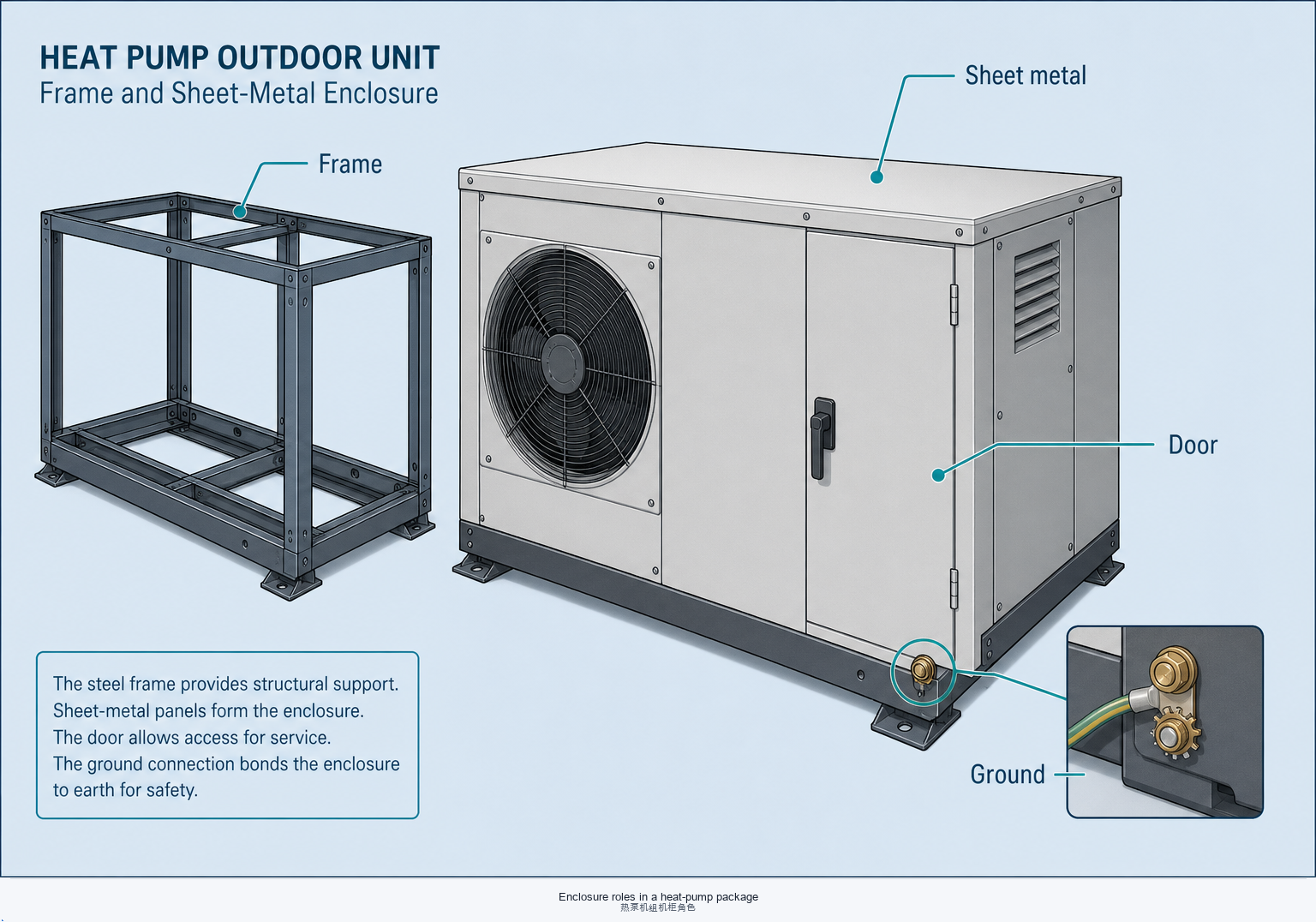
Strength & mounting
The frame carries compressor mass, vibration, shipping loads, and seismic or wind requirements where specified. Thin panels that rattle are a stiffness and fastening problem, not only a cosmetic one.
Grounding & bonding
Doors, panels, and DIN rails need intentional bonds so protective earth and EMC return paths stay continuous when covers open. Painted joints without bond straps are classic intermittent ground faults.
Serviceability
Filters, valves, EEVs, and terminal blocks must be reachable without dismantling the refrigeration circuit. Design for the technician with gloves—not only for the marketing photo with panels off.
2 · Frame, sheet metal, doors, and IP intuition
Geometry and sealing decide weather survival and acoustic behaviour. IP ratings are test conditions—not a promise that every gland and seam on site matches the brochure.
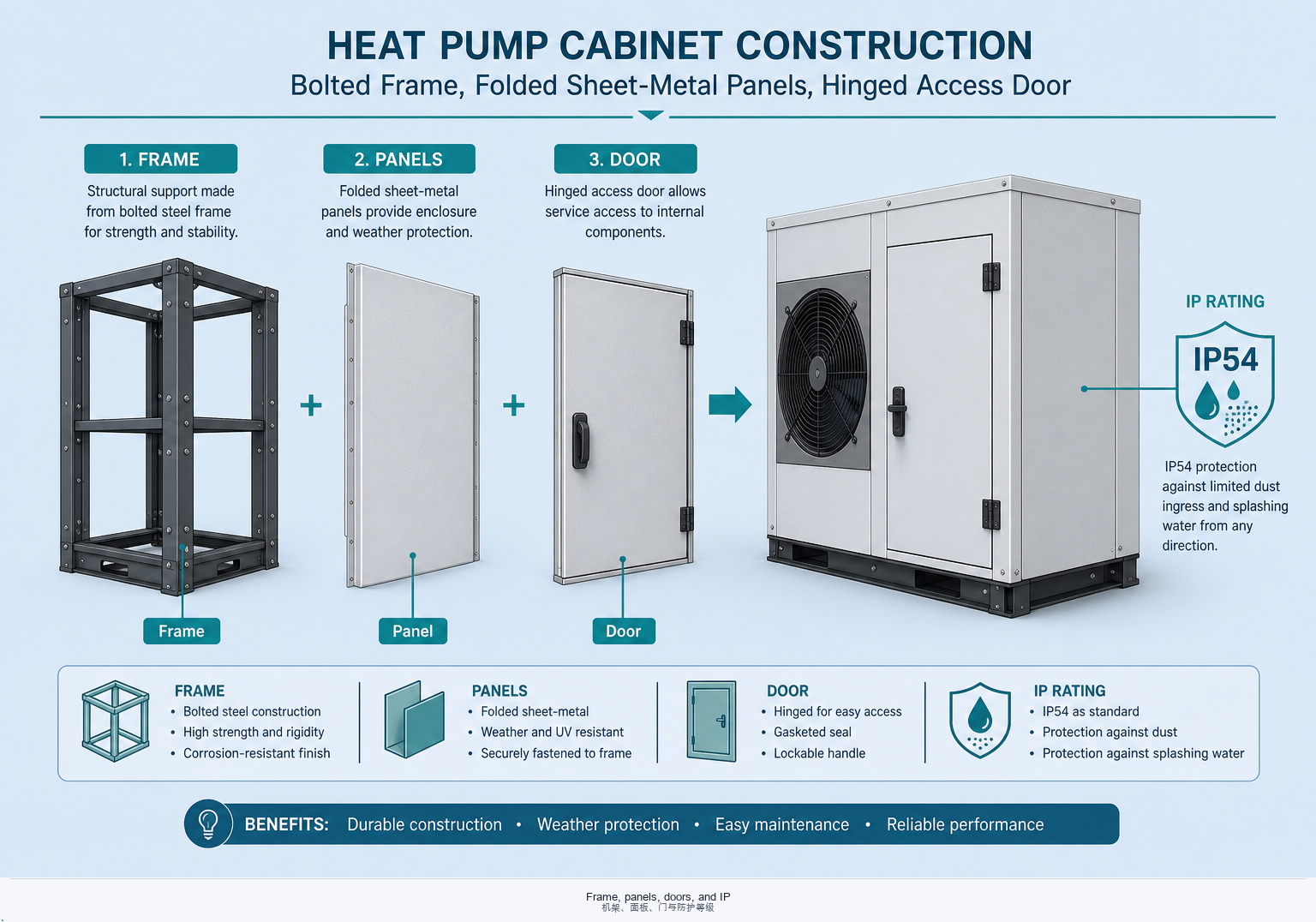
Frame & base
Base rails set fork-lift and foundation interfaces. Squareness and hole patterns decide whether compressors and exchangers align without forced piping—see piping stress.
Sheet metal & panels
Gauge, ribbing, and fastener pitch control panel oil-canning and acoustic radiation. Removable panels need captive hardware and clear labels for which cover exposes live parts.
Doors & hinges
Door swing must clear site walls and allow full rack access. Interlocks and earthing straps travel with the door—do not rely on the hinge alone as a bond path.
IP & weather intuition
Think water jets, dust, and condensate—not only “outdoor = IPX4.” Louvers, drip edges, and drain holes matter as much as gasket durometer. Flammable-refrigerant zones add enclosure rules—follow OEM and code.
3 · Power vs signal segregation, shielding, and EMC
Cabinets fail electromagnetically when VFD cables and sensor leads share a tray. Segregation and bonding are part of the electrical story—see the electrical & controls guide.
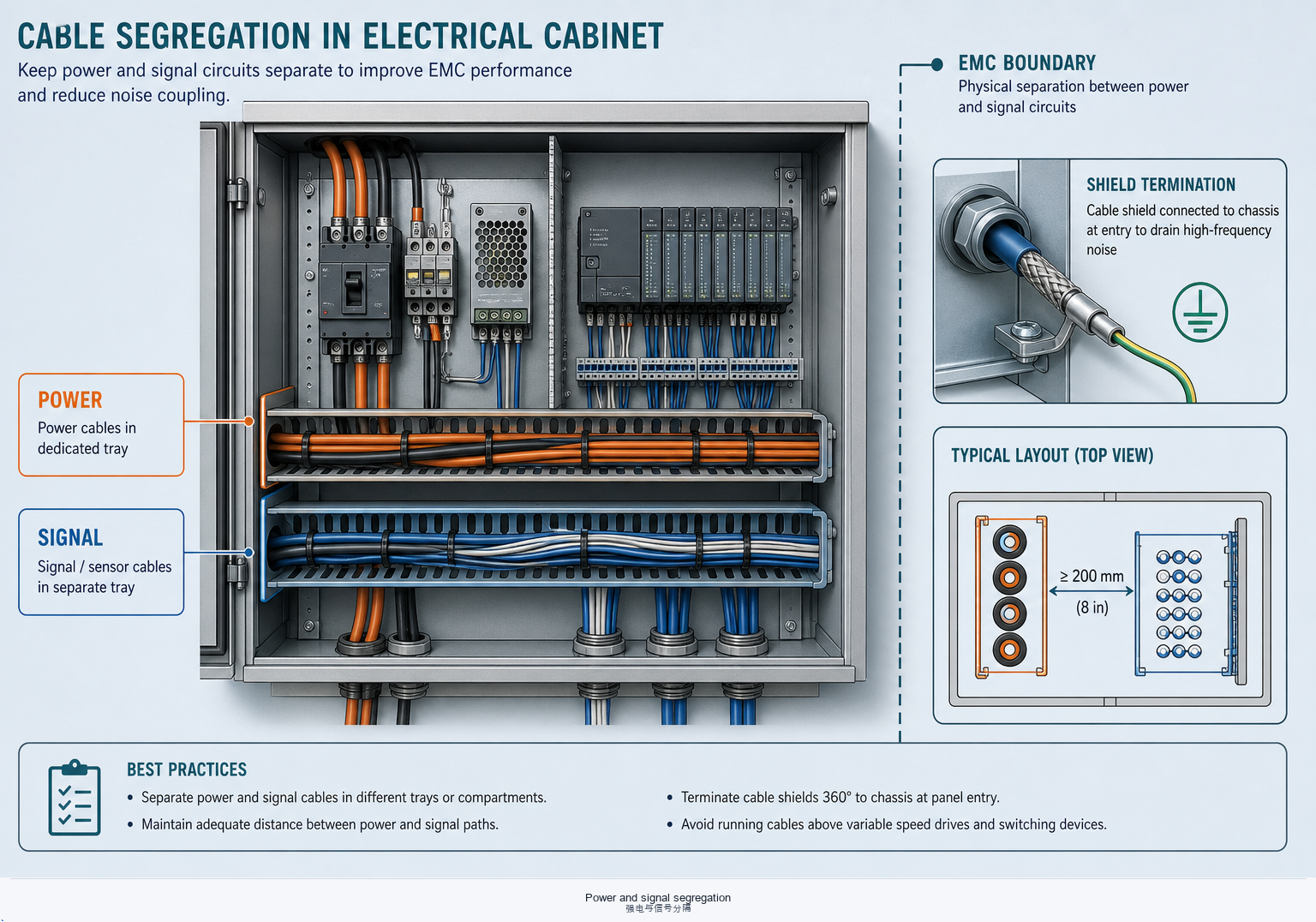
Power vs signal
Keep motor and mains conductors away from transducer and communication cables. Shared trunking is acceptable only with documented barriers or distance—habit is not a standard.
Shielding & bonding
Screened VFD cable and sensor screens need a defined bond strategy (360° gland, PE bar, or both). Random “earth wherever convenient” creates loops that inject noise into controllers.
EMC filters & layout
Filters and reactors only work when cable lengths and earthing match the drive manual. Stuffing a filter in a corner with long unscreened tails defeats the purpose—detail under VFDs.
One-sentence memory
EMC is a layout discipline—not a sticker on the drive nameplate.
4 · Cable trays, ties, and bend radius
Mechanical cable practice decides whether insulation and shields survive shipping and ten years of vibration.
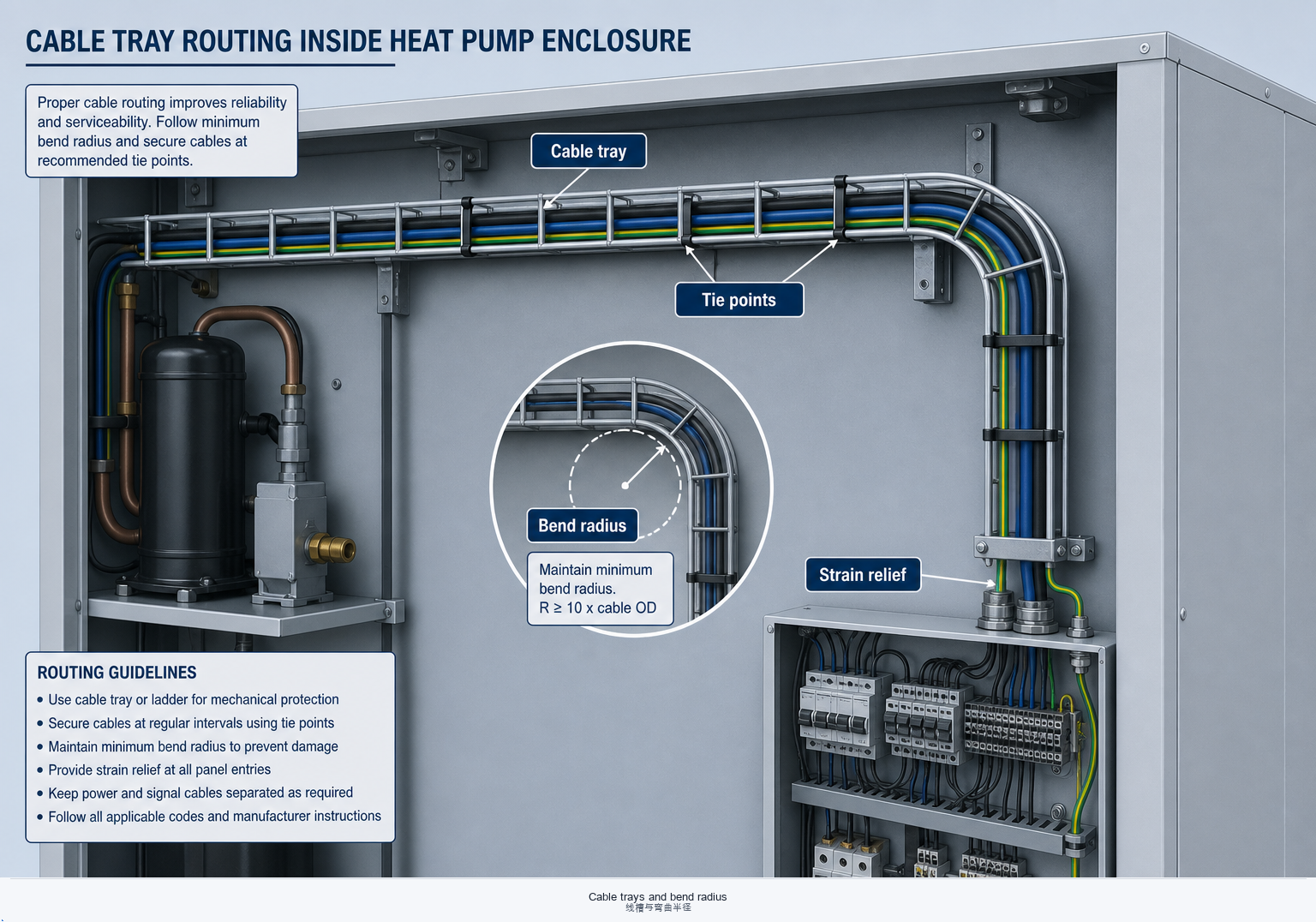
Trays & ducts
Size trays for fill and heat; separate power and signal levels. Sharp tray edges need grommets—vibration will saw through jackets.
Ties & strain relief
Support cables before connectors and glands. Avoid cinching screened cable so hard that the braid is crushed. Use UV-stable ties outdoors.
Bend radius
Respect manufacturer minimum radii for power, coax, and fibre. Forced bends at panel entries are a top cause of intermittent sensor faults after transport.
5 · Selection & build checklist
Treat the cabinet as a product interface: structure, safety, EMC, and maintainability on one sheet.
- Loads & mounts: shipping, operating vibration, foundation or roof curb interfaces defined.
- Access: coils, compressors, valves, and electrics reachable without cutting pipes—labels on live covers.
- Bonding: doors, panels, and DIN rail PE continuous; paint broken only where bonds land.
- Segregation & EMC: power vs signal trays; VFD cable and filters per electrical guide.
- IP & weather: glands, gaskets, drains match claimed rating; no field holes without sealing.
- Cable practice: tray fill, tie spacing, bend radii, and service loops documented for assembly and service.
Need drive, controller, and panel device detail? Continue at Electrical & controls.
6 · Quick FAQs
“Why does the controller trip only with the door open?”
Often a missing door bond or shield that relied on the closed panel as a return path. Bond straps and PE continuity belong in the design—not as a field patch.
“Can power and 0–10 V signals share one flexible conduit?”
Usually a bad idea next to VFD output. Segregate or use screened pairs with correct termination—see electrical & controls.
“Is a higher IP rating always better?”
Higher IP can trap heat and condensate if ventilation and drains are wrong. Match the environment and thermal design—not the largest number on a catalog page.
“Where next on this site?”
Electrical · Piping · Shop & test · Knowledge hub.
Enclosure IP tests, electrical codes, and OEM cabinet drawings vary by product and market. This page is engineering orientation—not a substitute for type-test reports, wiring diagrams, or site electrical design.