Heat pump basics · Shop & test
Shop & test knowledge guide
Quality is not a final stamp—it is a closed loop from assembly to ship: dry circuits, correct charge, proven function and safety, then mapped performance. A clean paint job with a wet vacuum and a soft torque wrench fails in the field. Pair with enclosure, piping, and electrical; this page focuses on shop tools and test benches.
1 · Quality loop from assembly to ship
Each station either catches a defect or ships it. Design the loop so vacuum, charge, leak, function, and performance cannot silently skip each other.
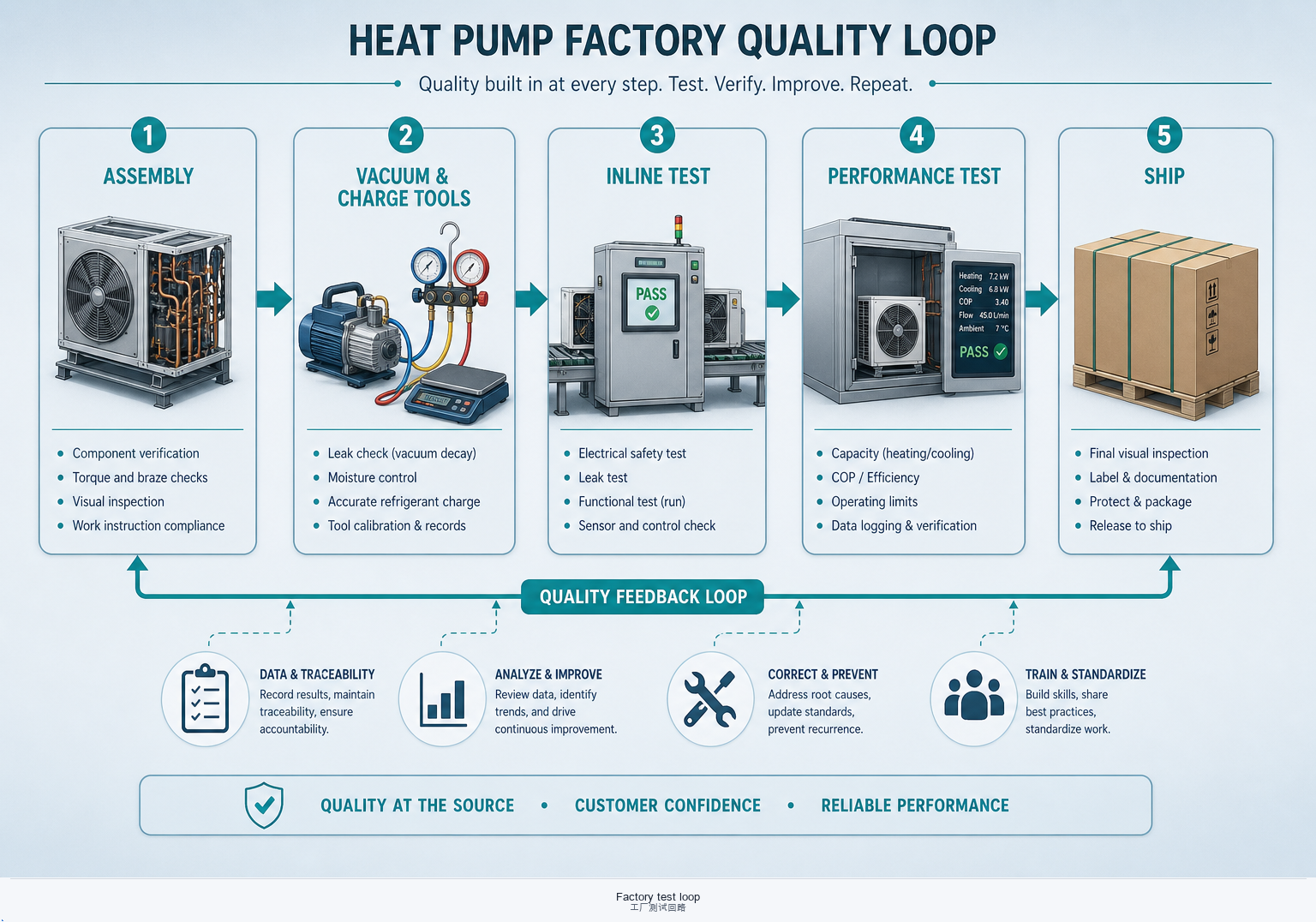
Assembly as a process
Torque, braze quality, wiring, and cleanliness set the ceiling for every later test. Rework after charge is expensive—catch mechanical and electrical defects dry when you can.
Prove dryness & tightness
Vacuum and leak methods protect oil and refrigerant chemistry as much as they protect the atmosphere. A “good enough” micron reading that rebounds is still wet—see lubricants moisture notes.
Function then performance
Inline benches ask “does it run safely?” Performance benches ask “does it meet the map?” Shipping on function alone without a defined performance policy is a commercial risk, not a shortcut.
2 · Tools: vacuum, charging, leak detection, torque
Shop tools are metrology devices. Uncalibrated gauges and worn torque wrenches invent false confidence.
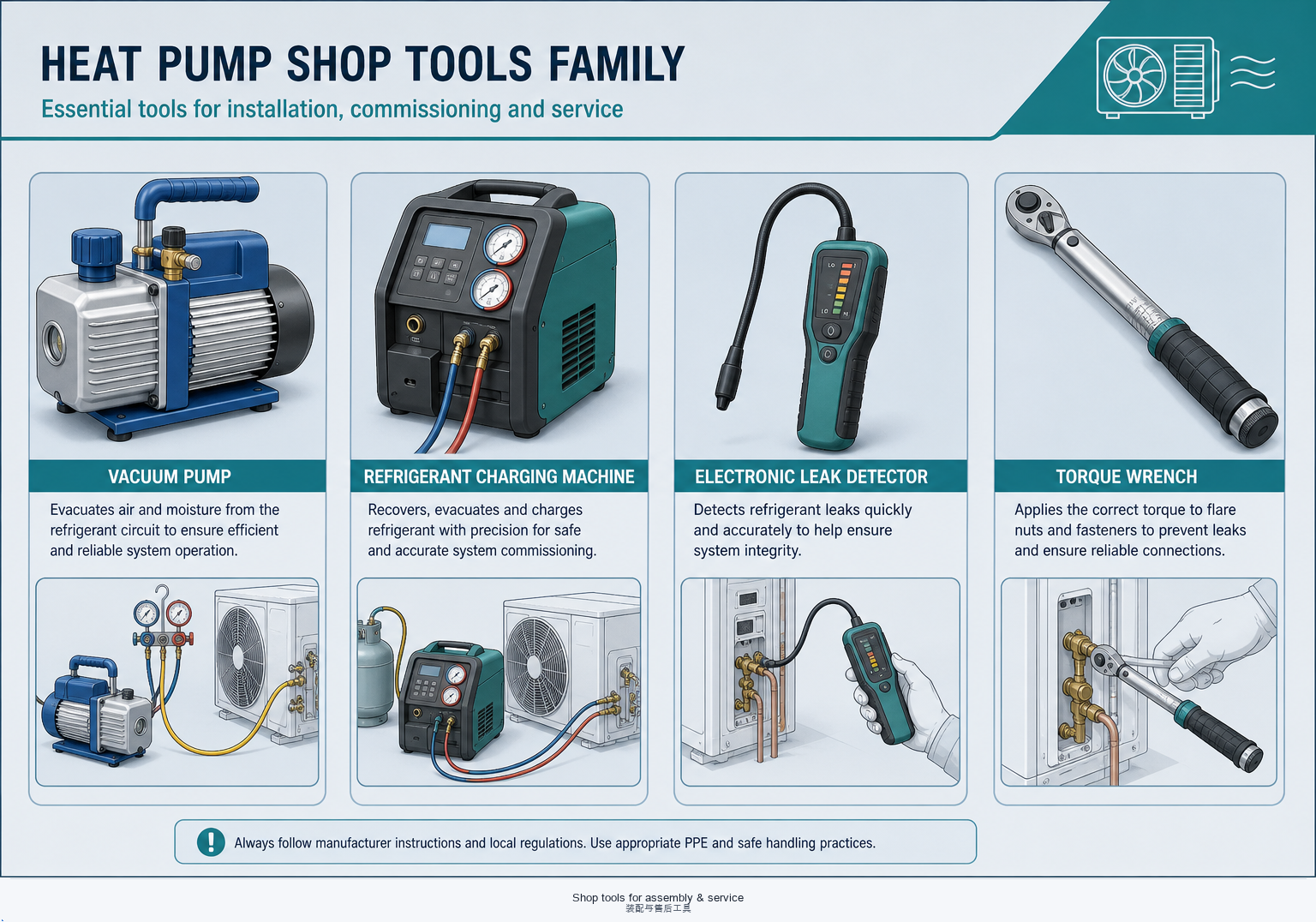
Vacuum pump & gauges
Deep vacuum removes non-condensables and moisture before charge. Use a micron gauge at the circuit—not only a pump-side dial. Blank-off tests reveal leaks and wet components.
Charging machines
Mass-based charge into a dry, leak-tight circuit beats “by sight glass.” Record fluid lot, oil type, and target mass. Wrong charge masquerades as a weak compressor on the performance bench.
Leak detection
Pressure decay, helium sniffers, and halogen detectors each fit different sensitivity and cycle-time budgets. Choose method by refrigerant, joint count, and regulatory threshold—not by habit alone.
Torque & assembly metrology
Flare, flange, and electrical torque windows prevent leaks and hot joints. Document setpoints; audit tools. Soft bolts after paint-bake cycles are a process issue, not “operator feel.”
3 · Inline / online test benches—function, safety, leak
Line benches are gatekeepers: they verify the unit can start, protect, and hold pressure before it consumes a scarce performance cell.
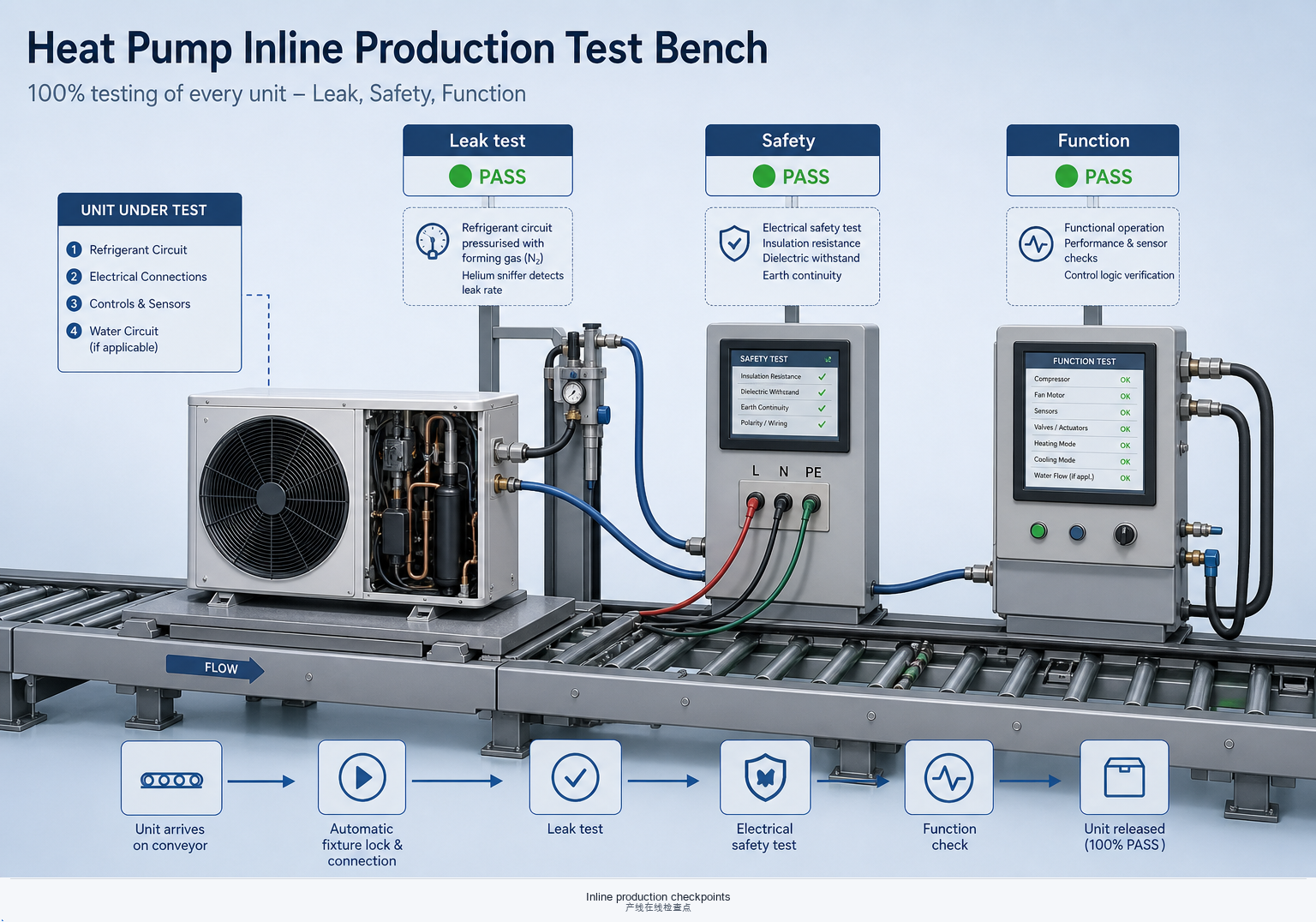
Function sequences
Mode changes, fan/pump start order, and controller self-tests catch wiring and firmware mismatches. Log fault codes—not only a green lamp.
Safety interlocks
Prove that pressure switches, flow cut-outs, and emergency stops inhibit as designed. Bypassing interlocks “to get throughput” ships a hazard.
Leak & pressure hold
Post-charge leak or nitrogen hold on the line catches assembly escapes early. Correlate fails to braze stations and torque audits—feed the quality loop.
Cycle time vs coverage
Not every unit needs a full map here. Define which defects inline owns versus which go to performance or audit sampling—and write it down.
4 · Performance test benches—duty points, COP, data acquisition
Performance cells turn thermodynamics into numbers buyers and engineers can argue about. Instrumentation and stability decide whether those numbers mean anything.
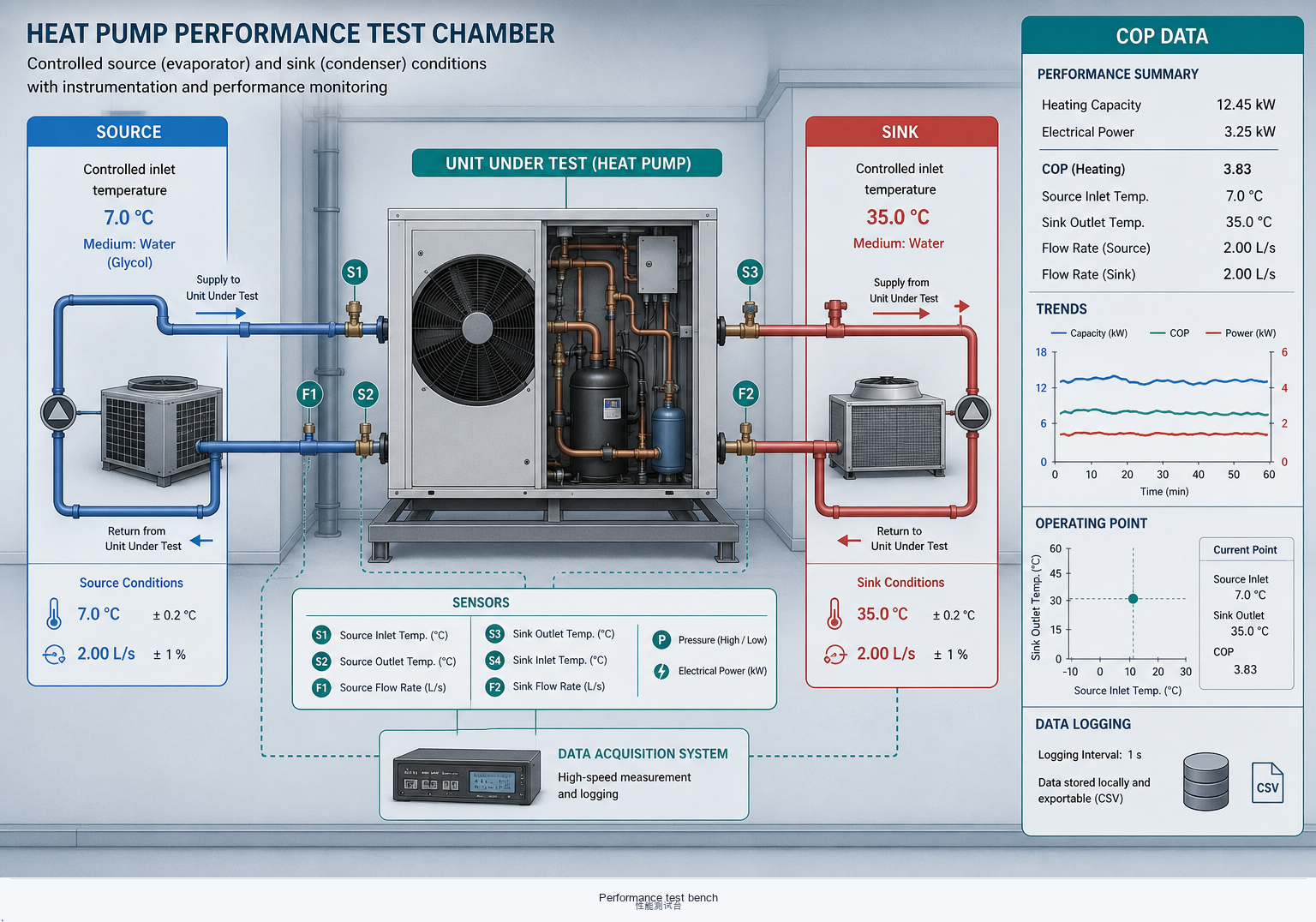
Duty points & envelopes
Rated points, part-load, and high-lift corners belong on the test plan. One nameplate condition is not a map—see compressor maps for why corners matter.
Capacity & COP
Capacity from balanced energy or refrigerant-side methods must reconcile with electrical input. Document uncertainty; do not oversell digits beyond sensor capability.
Data acquisition & traceability
Time-stamped P/T/flow/power with calibrated channels and unit serial linkage enable recalls and process learning. Spreadsheet-only “final numbers” age poorly in disputes.
One-sentence memory
A performance number without method, stability, and calibration is marketing—not engineering evidence.
5 · Shop & test checklist
Build the line so every shipped unit has a known dryness, charge, safety, and performance story.
- Vacuum & dryness: micron targets, blank-off criteria, and moisture-sensitive oil handling defined.
- Charge control: mass targets, fluid/oil lot traceability, no “top up by feel.”
- Leak method matched to refrigerant and joint risk; fails feed braze/torque audits.
- Inline gates: function + hard safety proved; interlocks never bypassed for rate.
- Performance policy: 100% vs sample, duty points, standard method, and DAQ retention period.
- Metrology: torque tools, gauges, and bench sensors on calibration; cabinet and wiring practice aligned with enclosure and electrical.
Need package build and EMC context? Continue at Enclosure & sheet metal.
6 · Quick FAQs
“Is a short vacuum enough if the pump sounds quiet?”
No. Use a micron gauge and blank-off. Quiet pumps can still leave wet circuits that attack POE oil—see lubricants.
“Why did performance fail after inline passed?”
Inline proves function and safety; performance proves capacity/COP at controlled conditions. Charge error, sensor placement, or map corners often show only on the bench.
“Do we need 100% performance test?”
Depends on risk, regulation, and process capability. What you must have is a written policy, calibrated method, and feedback into assembly—not silence.
“Where next on this site?”
Enclosure · Electrical · Piping · Lubricants.
Test standards, accreditation scopes, and OEM procedures vary by product and market. This page is engineering orientation—not a substitute for signed test methods, calibration certificates, or regulatory conformity evidence.