Heat pump basics · Refrigerants
Refrigerant knowledge guide
A structured, illustrated map of refrigerant history, today's transition, and regional law—for heat pump engineers, buyers, and decision-makers. For fluid properties see the working-fluid table or the on-site property calculator (PT/PH/PQ, P–h envelope); for project compliance always verify the current consolidated text in your jurisdiction. Not legal advice.
1 · Refrigerant generations & timeline
Refrigerant choice has always been a stack of thermodynamics, safety, cost, and regulation. The “generations” below overlap in time—industrial ammonia and CO₂ never left the field even as CFCs and HFCs dominated comfort HVAC.
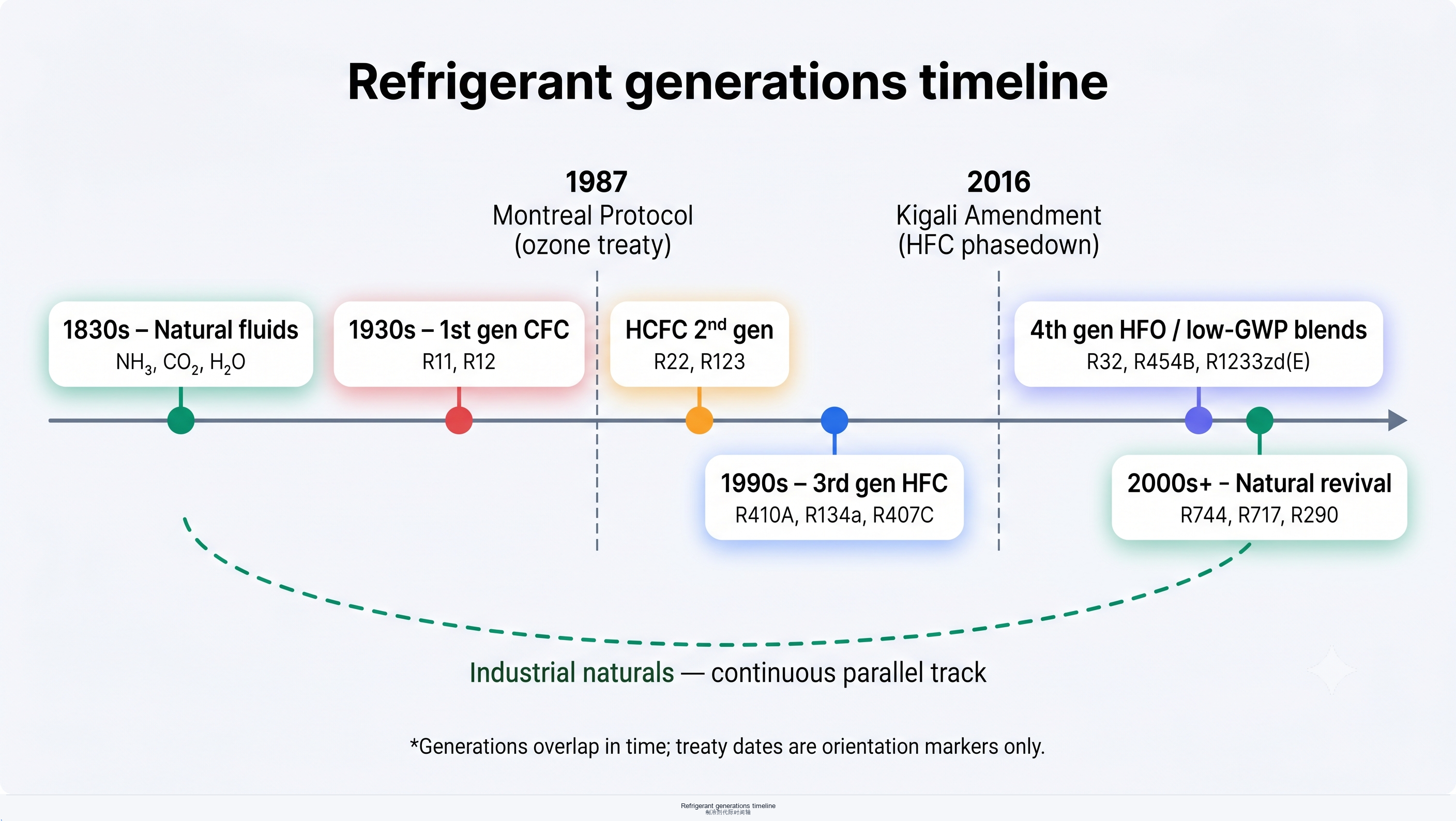
| Generation | Era | Examples | ODP | GWP (100-yr) | Heat pump use | Main driver |
|---|---|---|---|---|---|---|
| Natural (pre-synthetics) | 1830s–today | R717 (NH₃), R744 (CO₂), R718 (H₂O), SO₂ (historic) | 0 | 0–1 | Industrial & high-temp HP; CO₂ transcritical/commercial; ammonia process heat | Efficiency, cost; revived by ozone & climate policy |
| 1st — CFC | 1930s–1990s | R11, R12, R502 | High (0.6–1.0) | 4,000–10,000+ | Legacy chillers; largely phased out | Montreal Protocol ODS phase-out [1] |
| 2nd — HCFC | 1990s–2020s | R22, R123, R142b | Low–moderate (0.01–0.11) | 100–2,000 | R22 heat pumps & chillers (declining); retrofit markets | HCFC phase-out schedules under Montreal [1] |
| 3rd — HFC | 1990s–today | R134a, R410A, R407C, R404A, R245fa | 0 | 675–4,000+ (R410A ≈2088) [3][4] | Dominant in comfort & many commercial HP; industrial medium/high temp | ODS replacement; now constrained by Kigali & F-gas law [1][7][8] |
| 4th — HFO / low-GWP blends | 2010s–today | R1234yf, R1234ze(E), R1233zd(E), R32, R454B, R454C, R515B | 0 | <1 to ~700 (fluid-dependent) [3][4] | R410A replacements (R32/R454B); high-temp R1233zd(E); cascade upper stages | Kigali, EU F-gas, AIM Act; PFAS debates add uncertainty [1][7] |
| Natural revival (parallel track) | 2000s–future | R744, R717, R290, R600a, R718 | 0 | ≤3 (CO₂ = 1) | CO₂ HP (incl. extreme cold cascade); ammonia industrial HP; propane commercial | Climate policy, charge limits, IEA/industry decarbonisation roadmaps [5][6] |
ODP/GWP values: ANSI/ASHRAE Standard 34 & 2021 ASHRAE Handbook—Fundamentals, Ch. 29 [3][4]. Confirm against manufacturer data for project work.
2 · Current landscape & future directions
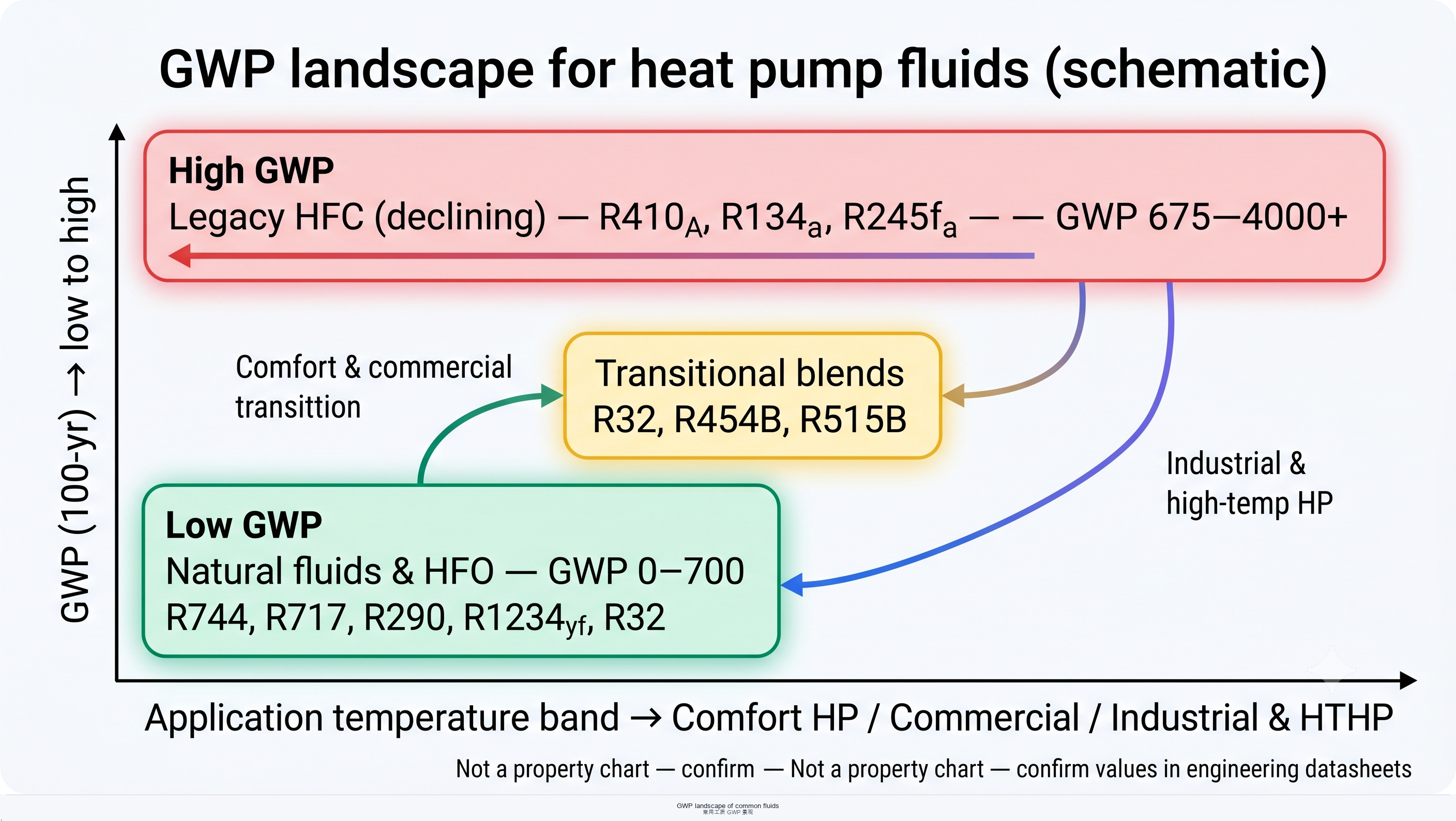
Two transitions run together: heat pump deployment at scale (driven partly by Paris NDCs and electrification [2]) and refrigerant switching (driven by Kigali and national F-gas law [1][7][8]).
Building & commercial HVAC
R410A → R32 / R454B / R454C is the dominant comfort-HP transition in many markets. The EU F-gas revision caps new split AC at GWP ≤750 from 2025 under Regulation (EU) 2024/573 [7]; Singapore NEA targets GWP ≤150 for new commercial refrigeration from July 2027. In the U.S., EPA Technology Transition rules under the AIM Act restrict high-GWP HFCs in new products by sector [8]—read together with SNAP end-use listings and stricter state rules (e.g. California CARB).
Industrial & high-temperature heat pumps
Industrial duty spans CO₂ (R744), ammonia (R717), propane (R290), HFOs such as R1233zd(E), and legacy HFCs (R245fa, R134a) in installed base. IIR Technical Brief No. 61 (2026) maps fluids for roughly 90–300 °C industrial decarbonisation [5]. Transition is slower than comfort HVAC because of charge size, safety class, and process integration—but policy pressure is building in parallel with demonstration projects reported at the 15th IEA Heat Pump Conference (Vienna, May 2026) [6].
PFAS & organofluorine chemistry uncertainty
Many HFOs and some HFC blends sit in broader PFAS / organofluorine regulatory debates—EU REACH restriction proposals and U.S. TSCA actions are not identical to F-gas quotas but can affect 15-year fluid strategy. Treat low-GWP HFO selection as a chemistry risk item, not only a GWP checkbox [7].
IEA & industry outlook
IEA analysis ties heat pump growth to grid decarbonisation and policy support; refrigerant transition is a stated enabler, not a side topic [6]. Expect parallel tracks: natural fluids and fourth-generation blends in new equipment, tighter service/reclaim rules on high-GWP banks, and more standardised test methods for low-GWP systems.
3 · International policy framework
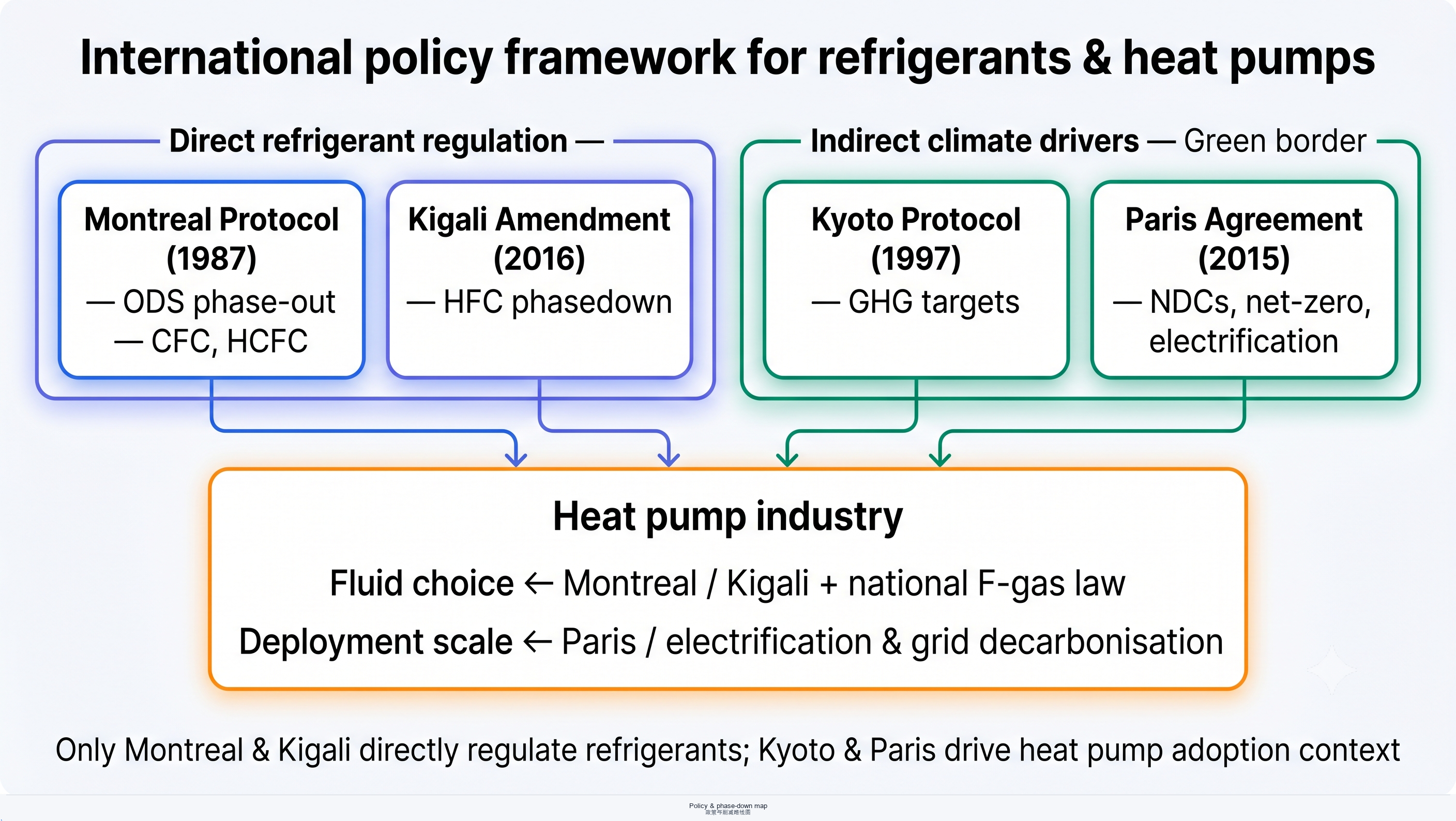
Four treaties are often named together—but only Montreal and Kigali directly regulate refrigerants. Kyoto and Paris shape the electrification and decarbonisation context that drives heat pump adoption [1][2].
| Instrument | Year | Direct refrigerant link | Heat pump impact |
|---|---|---|---|
| Montreal Protocol | 1987 | Direct — phases out ODS (CFCs, HCFCs) on Annex schedules [1] | Drove HFC adoption as ODS replacements; now HCFC banks declining |
| Kigali Amendment | 2016 | Direct — HFC production/consumption phasedown for ratifying Parties [1] | Low-GWP fluids and naturals become the compliance default direction |
| Kyoto Protocol | 1997 | Indirect — quantified GHG targets for developed countries [2] | Raised profile of HFC climate impact; precursor to Kigali HFC action |
| Paris Agreement | 2015 | Indirect — NDCs, net-zero pledges [2] | Electrification of heat; heat pumps as decarbonisation tool alongside grid cleaning |
Kigali HFC phasedown schedules [1]
Percentages are relative to each group's agreed HFC baseline (CO₂-eq). A5 includes China, India, and most developing countries—baseline years 2020–2022, with an initial freeze in 2024–2028 before step-downs begin.
| Party group | Baseline years | 2019–2023 | 2024–2028 | 2029–2033 | 2034–2036 | Final step |
|---|---|---|---|---|---|---|
| A1 (incl. EU, US, Japan) | 2011–2013 | 90% of baseline | 60% | 30% | 20% | 15% by 2036 |
| A5 (incl. China) | 2020–2022 | Baseline (100%) | Freeze at baseline | 90% (10% cut from 2029) | 50% cumulative by 2033 | 20% by 2045 (80% cut) |
4 · China · EU · United States — past, present, future
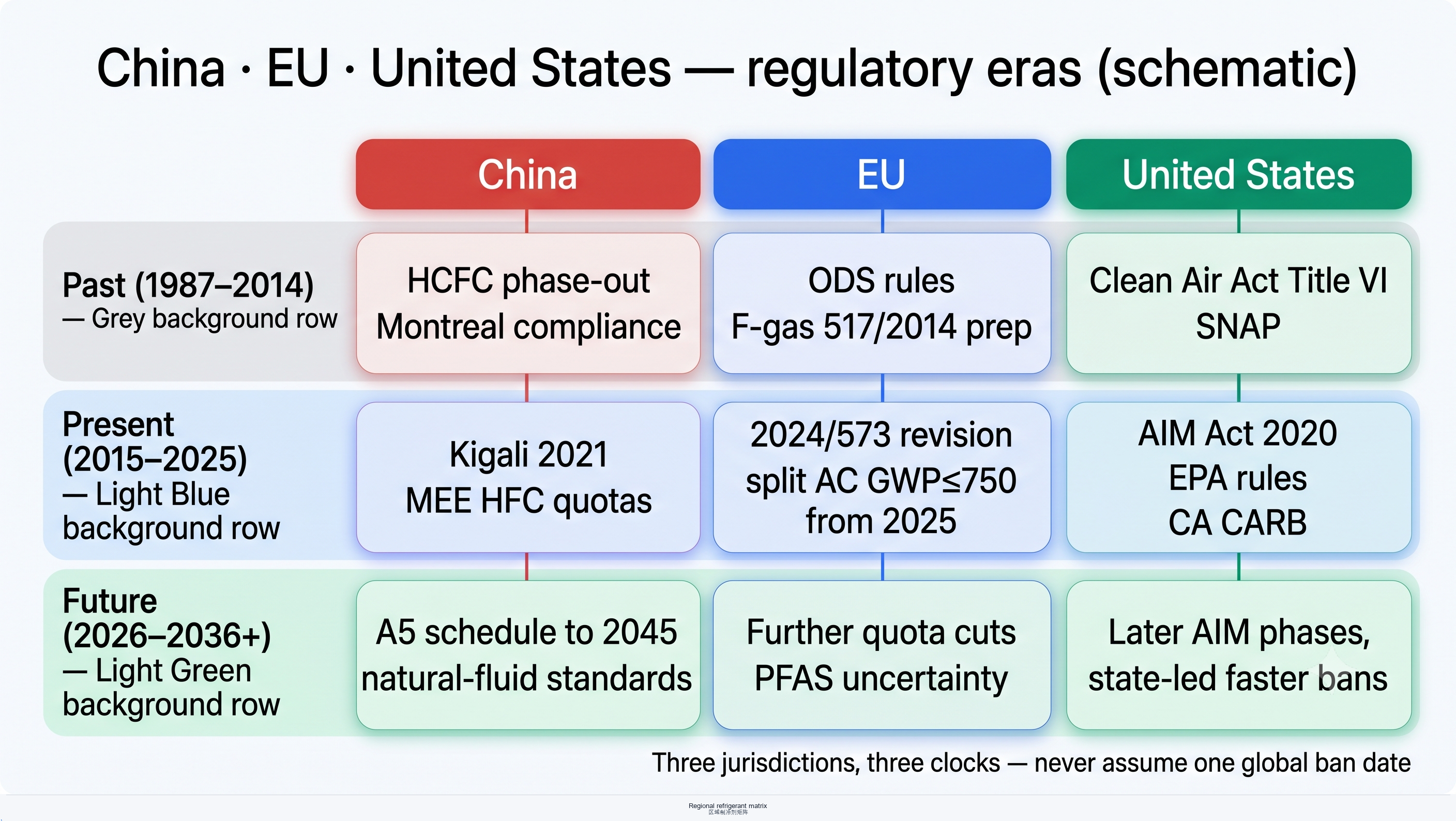
Kigali sets outer bounds; national and state law decides what you must comply with on each shipment. Dates below are orientation markers—verify consolidated texts before quoting in contracts [7][8][9].
Past (1987–2014)
| Dimension | China | EU | United States |
|---|---|---|---|
| Ozone layer (ODS) | Montreal Protocol implementation; HCFC production/consumption freeze and phased reduction per Annex adjustments [1][9] | EU ODS Regulation; transition from CFC → HCFC → HFC in equipment fleets [1] | Clean Air Act Title VI; SNAP substitute listings begin shaping acceptable fluids [1][8] |
| Climate (pre-Kigali) | Kyoto-era awareness of HFC climate impact; domestic standards evolve toward efficiency [2] | F-Gas Regulation 517/2014 enters force 2015—quota system for HFCs [7] | State action precedes federal HFC rules; EPA SNAP sector rules expand [8] |
Present (2015–2025)
| Dimension | China | EU | United States |
|---|---|---|---|
| HFC phasedown | Kigali in force 9 Sep 2021; MEE HFC production/import quota system with annual allocations [1][9] | 517/2014 quota cuts; 2024/573 revision tightens product bans & leakage rules—check consolidated text [7] | AIM Act (2020); EPA phasedown rules (40 CFR Part 84); Technology Transition Rule by sector [8] |
| Product / market rules | GB energy labels; GB/T 45650-2025 CO₂ HP standard; lower-GWP push in product supervision [10] | New split AC GWP ≤750 from 2025; UK F-Gas parallel but separate post-Brexit [7] | Federal GWP limits vary by sector; California CARB and other states often stricter [8] |
| Parallel chemistry track | Chemical controls evolving; PFAS not yet identical to EU REACH scope [7] | REACH PFAS restriction proposal adds long-term uncertainty for some HFOs [7] | TSCA PFAS reporting/restrictions; read alongside F-gas rules [8] |
Future (2026–2036+)
| Dimension | China | EU | United States |
|---|---|---|---|
| HFC trajectory | Quota tightening toward Kigali A5 schedule (80% cut by 2045); domestic natural-fluid standards expand [1][9] | Further F-gas quota cuts; possible PFAS restrictions affecting HFO supply chains [7] | EPA later AIM phases; state-led faster bans on high-GWP fluids in new equipment [8] |
| Heat pump direction | Industrial HP policy push + natural fluids (CO₂, R290, NH₃); see policy map [9][10] | Natural fluids and <150 GWP blends in more applications; industrial HP in decarbonisation packages [5][7] | Electrification incentives + HFC phasedown drive low-GWP HP lines; industrial adoption growing [6][8] |
Application milestones (examples—verify locally)
| Application | China | EU | United States |
|---|---|---|---|
| New split air-to-air HP | Quota + product standards trend toward lower GWP; no single EU-style product GWP cap nationwide yet—track MEE & SAMR updates [9] | GWP ≤750 for new split AC from Jan 2025 (2024/573) [7] | EPA Technology Transition: sector-specific GWP limits; e.g. most new residential/light commercial AC moving off R410A-class fluids [8] |
| Commercial chillers / rooftops | HFC quota affects supply; R32/R410A transition in progress in new equipment [9] | High-GWP HFC bans in many new stationary applications under F-gas product lists [7] | SNAP + AIM sector rules; check EPA listings for each chiller type [8] |
| Industrial / high-temp HP | CO₂, NH₃, R290, HFO routes; GB/T 45650-2025 for CO₂ HP [5][10] | Natural fluids favoured; large charge permits & safety rules apply [5][7] | Ammonia/CO₂ well established in industrial; HFO adoption in high-temp HP growing [5][8] |
| Servicing / reclaim | HFC consumption capped by quota; reclaim infrastructure expanding [9] | Service bans on high-GWP virgin fluid in certain equipment; leak-check thresholds tightened [7] | AIM allocation + reclaim requirements; state reclaim rules may add requirements [8] |
5 · Heat pump selection & compliance practice
Before locking a fluid for a 15-year plant, walk this sequence—then cross-check against the property table and destination law.
- Define the application band: source/sink temperatures, lift, capacity swing, and whether duty is comfort, process, or high-temperature industrial [5].
- Screen fluids by physics: critical temperature, pressure envelope, glide, material compatibility—use ASHRAE Std 34 data [3][4].
- Classify safety: toxicity and flammability (A1/A2L/A3/B2L etc.); charge limits and room volume rules drive site layout [3].
- Map every destination market: where equipment is sold, installed, and serviced—China, EU, US federal, and strictest state (e.g. California) may differ [7][8][9].
- Plan the 15-year path: virgin fluid availability, reclaim, spare parts, and whether PFAS/chemistry policy affects your HFO choice [7].
One-sentence memory
Physics picks what can work; the jurisdiction you ship to and service in picks what may be sold and maintained—map Kigali first, then national instruments, then your safety case.
Quick FAQs
“Is R-410A banned on the same calendar worldwide?”
No. Even where HFC phasedowns exist, application lists, grace periods, and servicing rules differ by region. One date in one regulation is not automatically global law [7][8][9].
“If we pick ammonia or CO₂, are we free of F-gas rules?”
You avoid most HFC quotas, but still face pressure-equipment, toxicity/charge, occupational safety, and possibly chemical policy for other fluorinated products on site [3][7].
“Domestic sale vs export—same fluid label?”
Often no. China domestic labels, EU CE/F-gas requirements, and US EPA certification paths can diverge for the same compressor platform—build a compliance matrix per SKU [7][8][9].
“Industrial plant with a large HFC charge—can we just keep topping up?”
Quota and service rules are tightening globally. Plan reclaim, retrofit, or fluid change before virgin supply or legal service windows close for your fluid [1][7][9].
“Where do I start for China industrial heat pump policy?”
Pair this guide with the site industrial heat pump policy map for national action plans, carbon assessment, and natural-fluid direction [9].
6 · Key references
Numbered sources cited in this guide. Verify dates and thresholds against current consolidated legal texts before contract or compliance use.
- [1] UNEP Ozone Secretariat — Montreal Protocol & Kigali Amendment texts, handbooks, and party data.
- [2] UNFCCC — Kyoto Protocol; Paris Agreement (climate framework context).
- [3] ANSI/ASHRAE Standard 34-2022 — Designation and Safety Classification of Refrigerants.
- [4] 2021 ASHRAE Handbook—Fundamentals, Chapter 29 — ODP/GWP tables for common refrigerants.
- [5] IIR Technical Brief No. 61 (2026) — High-Temperature Heat Pumps for Industrial Decarbonisation.
- [6] IEA — Heat Pump Centre reports; 15th IEA Heat Pump Conference (Vienna, May 2026) public summaries.
- [7] EU — Regulation (EU) 2024/573 (F-gas revision); REACH PFAS restriction process.
- [8] U.S. EPA — AIM Act HFC phasedown; SNAP Program; 40 CFR Part 84.
- [9] China MEE — HFC production/import quota management measures and annual quota announcements (生态环境部 HFC 配额管理).
- [10] GB/T 45650-2025 — Carbon dioxide air source heat pump units (see also standards quick reference).
Orientation only — not legal advice. Verify current consolidated texts before quoting ban dates or GWP thresholds in contracts.
Refrigerants
Common heat pump refrigerants
Reproduces Table 2 from the IIR Technical Brief A Key Technology for Industrial Decarbonisation (61st IIR Technical Brief, 2026), with additional rows for common HVAC heat-pump fluids (R-32, R-410A, R-454B, R-454C) from ASHRAE Standard 34. For fluid screening and safety-class orientation only—confirm against manufacturer data and site regulations.
Working-fluid properties (IIR Table 2 + ASHRAE Std 34 supplement)
| TYPE | REFRIGERANT | CHEMICAL NAME (EN/ZH) | FORMULA | tcr (°C) | pcr (MPa) | NBP | ODP | GWP | SAFETY |
|---|
IIR Table 2 data from [31] and [32], unless otherwise specified. a: [33], b: [34], c: [35], d: [36], e: [37]. Rows marked f (R-32, R-410A, R-454B, R-454C, R-134a, R-245fa, R-142b, R-515B): ANSI/ASHRAE Standard 34 Tables D-1/D-2; 2021 ASHRAE Handbook—Fundamentals, Ch. 29 Tables 3–5 (GWP100). Chemical names and compositions: ANSI/ASHRAE Standard 34-2022 Refrigerant Designations.
R&D roadmap & adoption barriers → HTHP column