熱泵基礎 · 換熱器
換熱器知識導讀
Heat exchangers set temperature approach, pressure drop, and much of the oil-return story. “Plate vs shell-and-tube” is not a slogan—it is a match of duty, fluids, and maintainability. This illustrated guide covers families, flow and transfer intuition, how to read a duty point, reliability risks, and heat-pump / HTHP specifics. Pair with the 壓縮機 and 閥件 guides; OEM tools sit under 工具與標準.
1 · 在蒸汽壓縮循環中的角色
Compressors create pressure; exchangers move the heat. Evaporators absorb, condensers (or gas coolers) reject—and optional IHX / economizers reshape the cycle between them.
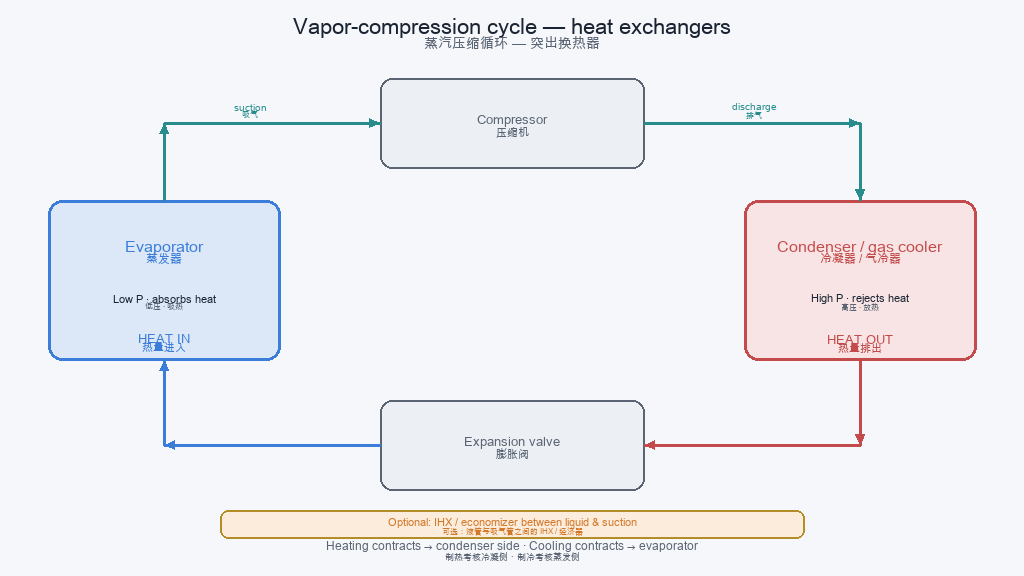
蒸發器 · 冷凝器 · 氣冷器
At subcritical pressures the condenser rejects latent heat. Transcritical CO₂ often uses a gas cooler instead—same job, different thermodynamics. Always name which side is the contract metric.
接近溫度影響 COP
接近溫度越小,壓縮機所需升程越低,但換熱器換熱能力(UA)、造價與壓降往往更高。「越小越好」並非免費。
IHX / 經濟器是輔助
中間換熱器與經濟器,用吸氣過熱換取液路過冷,或提供中間補氣。它們是循環選項,不能替代蒸發器/冷凝器本身的正確選型。
2 · 結構家族
沒有一種結構能覆蓋所有容量、介質組合與檢修條件。先按家族初篩,再在廠家軟件中用你的溫度與流量確認。
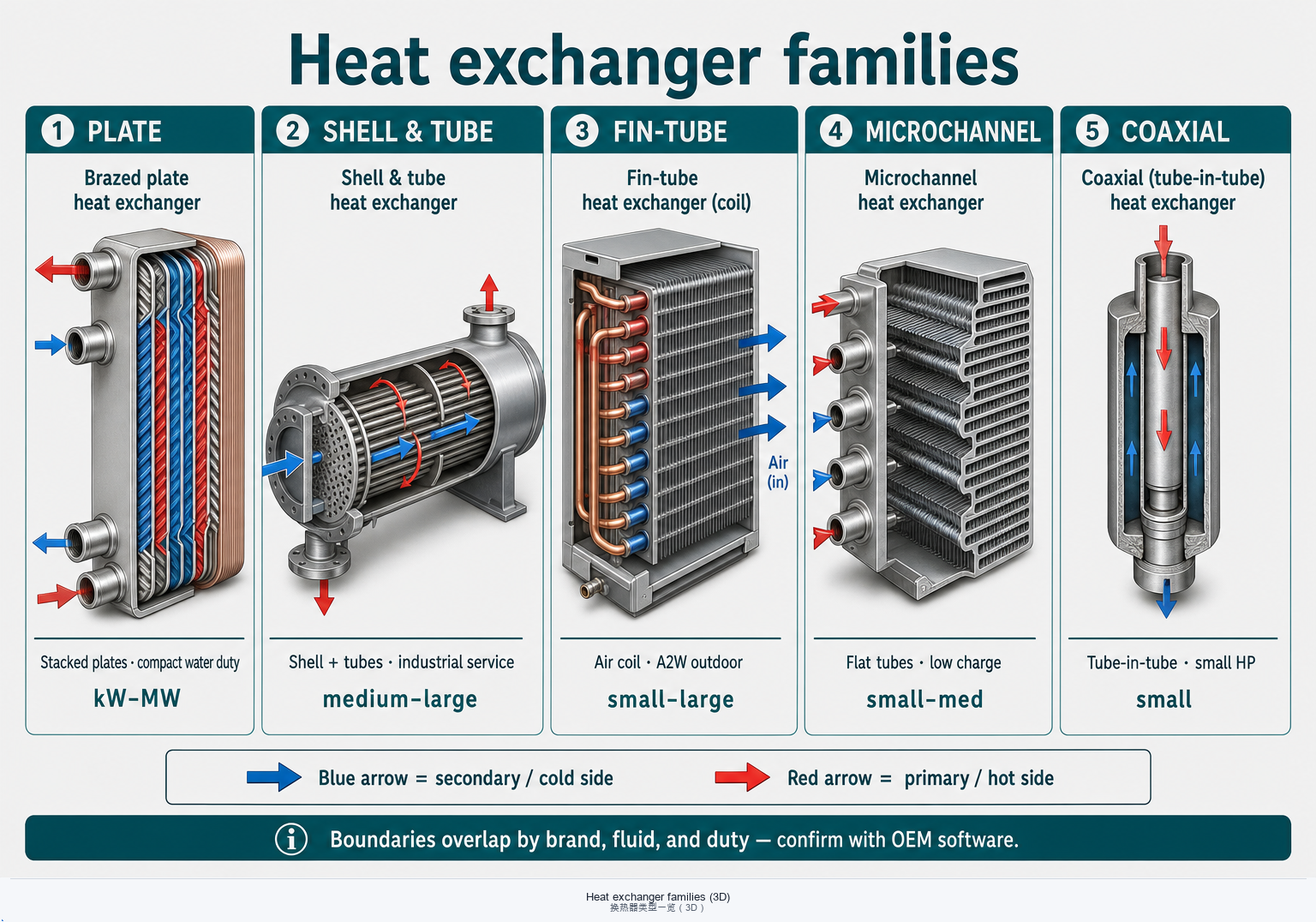
| 家族 | 典型容量段 | 典型介質 | 壓降 / 可清洗性 | 熱泵選型直覺 |
|---|---|---|---|---|
| 板式(釺焊 / 可拆) | 小–大(kW 至 MW 級疊板) | 製冷劑–水/鹽水;液–液 | 緊湊;可拆式可清洗;釺焊式難清洗 | 整機式熱泵水路側主力 |
| Shell & tube | 中–大 | 製冷劑–水;工藝流體 | 管束可檢修;有滿液/乾式等變體 | Industrial chillers & many HTHP sinks |
| 翅片管(空氣盤管) | 小–大 | 製冷劑–空氣 | Air ΔP & frost dominate O&M | Outdoor / indoor coils on A2A & A2W |
| 微通道 | 小–中 | 製冷劑–空氣;充注量低 | Low charge; repair & fouling differ from Cu/Al | 對充注敏感的 A2L / R290 平臺 |
| 套管 / 同軸 | 小 | 製冷劑–水 | 結構簡單;檢修受限 | 緊湊水路熱泵 / 特種機組 |
滿液、降膜等是殼管的工業變體——選型要看回油與液位控制,不能只看樣本上的 kW。
3 · 流路佈置與傳熱
逆流、叉流、並流會改變在相同進出口溫度下能達到的對數平均溫差(LMTD)。接近溫度與 UA 是選型會上的實用用語。
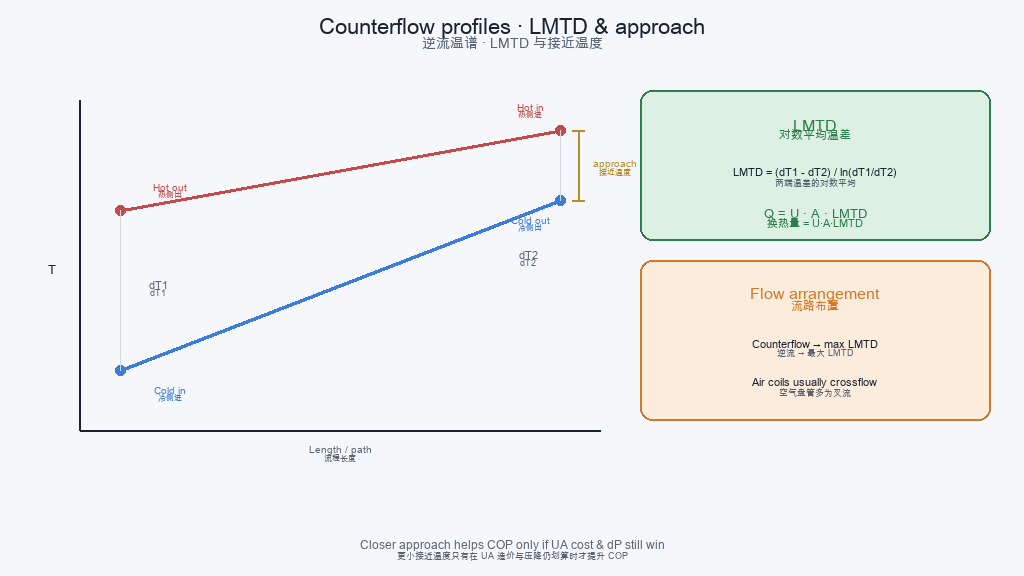
逆流 vs 叉流
給定進出口溫度時,逆流的 LMTD 最大。空氣盤管多爲叉流;水路板換採用多流程時常近似逆流。
接近溫度
接近溫度是製冷劑飽和(或出口)溫度與二次流體之間的溫差。應寫進規格——宣傳上的「kW」往往隱含了偏寬鬆的接近溫度。
UA / NTU 直覺
UA 反映換熱器「尺寸」;NTU 把 UA 與流體熱容流聯繫起來。便於初步判斷——最終仍需工質物性、污垢係數與廠家關聯式。
一次側 vs 二次側
兩側都要寫清楚:工質牌號與含油情況、水/鹽水水質、空氣溼度。腐蝕與凍結風險多在二次側,銷售材料裏未必寫全。
4 · 性能 / 工況怎麼讀
樣本上的千瓦數,是在特定進出口溫度、流量與污垢假設下的一個工況點——不能當成可隨意套用的標稱值。
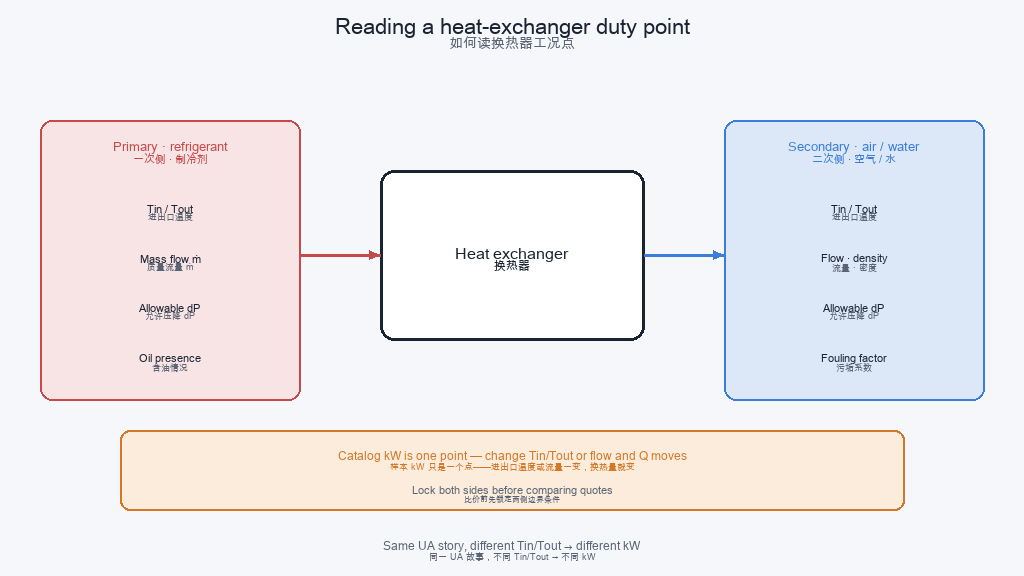
工況 ≠ 銘牌
進出口溫度或流量一變,換熱量就變。報價若省略二次側條件,你還沒有在比較同一臺換熱器。
壓降要進預算
Water ΔP hits pump power; air ΔP hits fan power and frost behavior. “More plates / denser fins” can steal seasonal COP even when peak kW looks fine.
Fouling factor & 標準
Ask which fouling factor and which rating standard sit behind the number. Align with the same boundary used for the compressor map and expansion control.
一句話記憶
Same UA story, different Tin/Tout → different kW. Approach and ΔP belong in the contract language.
5 · 結垢、結霜、油膜與凍結
許多「換熱器太小」的投訴,其實是結垢、結霜、油膜或防凍不到位——而不是少了幾平方米換熱面。
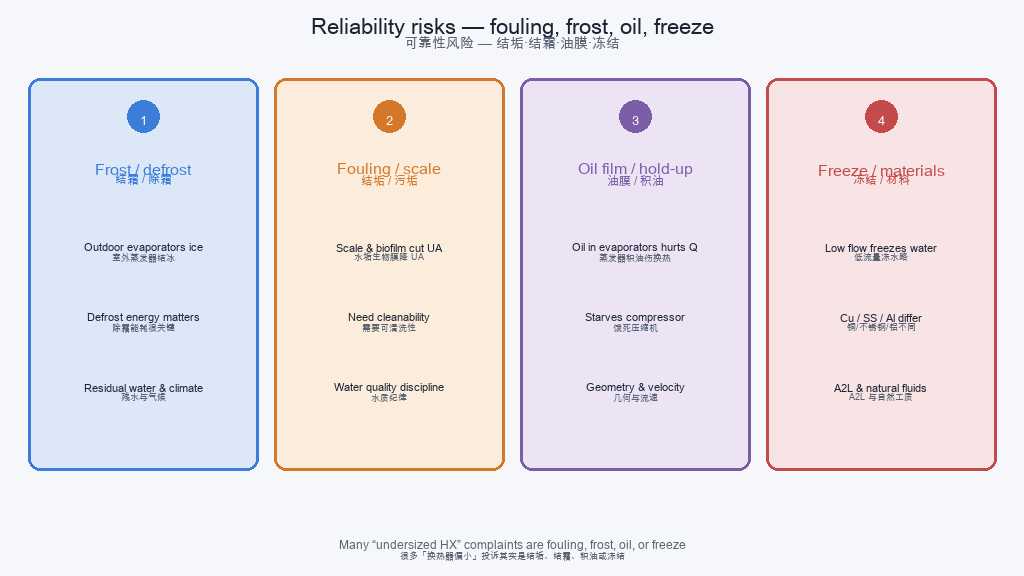
空氣側結霜
外機蒸發器在表面溫度足夠低、空氣溼度足夠高時會結冰。化霜能耗與殘水,與峯值容量表同樣重要。
水側結垢
水垢與生物膜會降低 UA。必須定期清洗時,可拆板換與殼管更合適;密封釺焊板換更依賴水質管理。
Oil film & hold-up
Oil stranded in evaporators hurts heat transfer and starves the compressor. Geometry and velocity are part of HX selection—see also the compressor oil chapter.
Freeze & materials
流量過低或控制失靈可凍裂水路。銅、不鏽鋼、鋁的腐蝕與維修特點不同——採用 A2L 或天然工質時更應儘早確認材質。
6 · 熱泵與高溫工況特化
Large lift and tight approach pull in opposite directions. Comfort A2W and industrial HTHP need different exchanger languages.
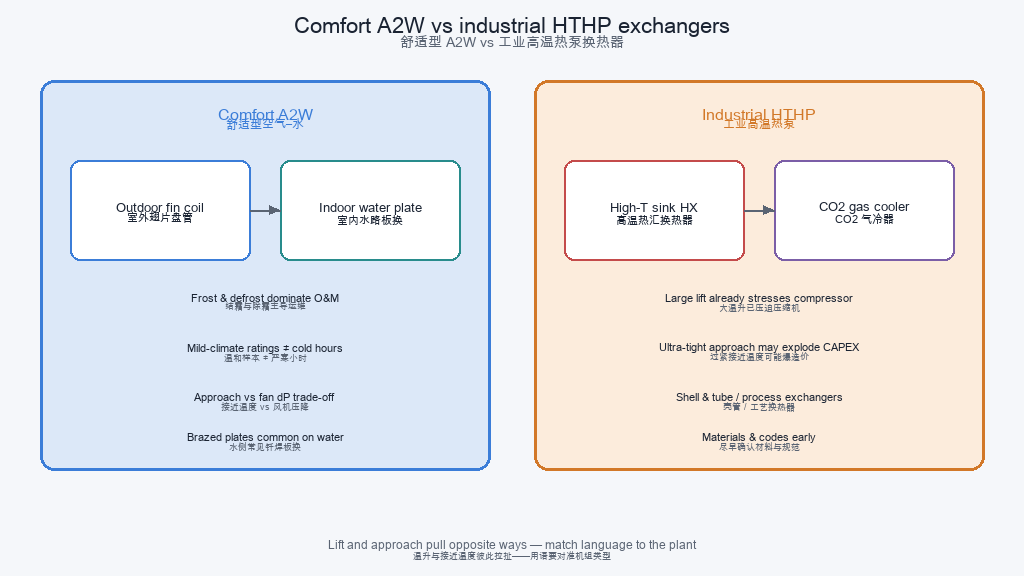
升程 vs 接近溫度
熱匯溫度已經很高時,壓縮機負擔本就很重。冷凝側再強求極小接近溫度,往往大幅抬高投資,卻換不來成比例的 COP 收益。
水–水 vs 空氣源
水–水板換沒有結霜問題,但仍有結垢與凍結風險。空氣源則受氣候與化霜影響——應按可信的寒冷時段選型,而不是隻看溫和額定點。
CO₂ 氣冷器
Transcritical rejection is sensitive to gas-cooler exit temperature. Ambient and approach design dominate seasonal performance—pair with the refrigerant guide.
工藝 / HTHP 熱匯側
溫度、壓力或介質化學性質超出舒適板換適用範圍時,應改用殼管或專用工藝換熱器。材質與規範要求儘早確認。
7 · 選型清單
比較「元/kW」之前,先鎖定兩側介質條件與可維護性要求。
- Fluids & corrosion: refrigerant (and oil), water/brine chemistry, air contaminants.
- Design temperatures: Tin/Tout or approach on both sides at design and a realistic off-design point.
- ΔP budget: pump/fan power and minimum flow for freeze / oil return.
- Maintainability: cleanable vs sealed; spare plates/tubes; freeze protection.
- Rating boundary: same standard and fouling factor as the contract / compressor map.
- System match: compressor envelope and expansion / reversing valves sized for the same duty.
Still stuck on mismatched “元/kW”? See fundamentals · pricing & standards.