Open Knowledge

Start with a question. Read the basics, prepare site data, or find an engineering reference.

先選擇你現在的問題

不必先學完所有知識,才能開始

學習順序

面向學習和教學。收費培訓仍在專業支持;這一順序是開放閱讀。

  1. 先讀原理
  2. 再讀公開學習案例
  3. 有項目時再做初篩
Guides for a specific site question
Browse all engineering topics
Reference datasets · planned
爲什麼鍋爐“很簡單”,而熱泵看起來“很複雜”?

第 2 講 · 認知

爲什麼鍋爐“很簡單”,而熱泵看起來“很複雜”?

鍋爐是“造熱”,熱泵是“搬熱”。一旦要跨越溫差把熱從低溫搬到高溫,物理邊界、工質邊界、設備邊界和系統邊界都會疊加,方案自然分化成很多種。

鍋爐爲什麼能方便解決各種用熱?

  • Human version: it’s like a big kettle: fuel/electricity goes in, hot water/steam comes out.
  • Engineering version: it converts energy to heat directly; you mainly manage combustion/electrics, heat transfer area, and safety codes.
  • What you “spec”: outlet temperature/pressure and capacity; the rest is relatively standardized.

熱泵爲什麼會分成那麼多“形式”?

  • Human version: it’s a “heat elevator”: you must lift heat from low temperature to high temperature.
  • Engineering version: the required temperature lift (ΔT) sets pressure ratio, discharge temperature, and efficiency limits—forcing different cycles.
  • What you must fit: the heat source, heat sink, temperature curves, and site constraints; the “machine” is only one part.

熱泵看起來復雜的 6 個真實原因

1)溫升(ΔT)會改變一切

小溫升:單級蒸氣壓縮通常就很合適;大溫升:往往需要經濟器、兩級、復疊、吸收、蒸汽壓縮等循環,才能把效率與可靠性維持在“安全區間”。

2)熱源形態差別巨大

空氣/水/鹽水/煙氣/工藝餘熱/溶液流……結垢腐蝕、凍結風險、溫度波動都不同,所以最佳循環與換熱器方案會變。

3)熱匯不只是“熱水”

熱水、熱風、蒸汽、導熱油的溫度要求與曲線不同。很多項目裏,“溫度曲線匹配”比銘牌 COP 更關鍵。

4)工質受“物理 + 安全 + 法規”共同約束

不是“想用哪個就用哪個”。臨界溫度、壓力等級、溫度滑移、材料兼容、安全等級(可燃/毒性)、環保與法規(F-gas/PFAS 等)會把方案推向不同工質家族。

5)壓縮機/膨脹機形式決定可行工作區間

渦旋/螺桿/活塞/離心,蒸汽壓縮與製冷壓縮,無油與噴油,各自有不同的“高效與可靠工作地圖”,從而影響循環選擇與分級方式。

6)工業現場的本質是系統集成與可靠性

工廠不能停機。冗餘、除霜、部分負荷控制、旁通、蓄熱(冷)、調試計量與驗收邏輯,會把熱泵變成“系統工程問題”,而非單一設備問題。

一句話記憶

鍋爐是“能量 → 熱”;熱泵是“熱 → 更高溫的熱”。邊界越多,變體越多。

Want the cycle families drawn out (reverse Carnot, Brayton, VCC upgrades, transcritical CO₂, absorption, steam/MVR)? Continue in the cycle guide.

常見誤解澄清

“熱泵不就是空調反過來用嗎?”

核心思路相關,但工業熱泵往往面臨更大的溫升、更復雜的熱源、更嚴苛的可靠性,以及蒸汽/高溫熱水等目標,因此循環與設備尺度都會不同。

“直接選 COP 更高的機組不就行了?”

COP 強依賴熱源/熱匯溫度與部分負荷行爲。很多項目的關鍵在“工藝耦合 + 穩定運行小時數”,而不是一本樣本上的單點 COP。

極寒與復疊:爲何常建議把 CO₂ (R744) 路線納入比選?

第 1 講 · 極寒與復疊

極寒與復疊:爲何常建議把 CO₂ (R744) 路線納入比選?

—— 常規氟系統復疊與 CO₂ 復疊路線對照(供方案討論參考)

在約 −20℃ 以北的低溫冰雪地區,空氣源熱泵往往會更直接地撞上低溫低壓、大壓比等物理約束。採用常規氟系統復疊(例如 R410A/R32 + R134a)若未針對極寒充分校覈,現場較常見的是出力下滑、能效變差或頻繁保護停機——具體表現因設計點、除霜與控制策略而異。

As an industrial heat-pump R&D team we standardize on CO₂ (R744) + R515B full cascade: not “more metal for show”, but a consequence of thermodynamics and lifecycle economics.

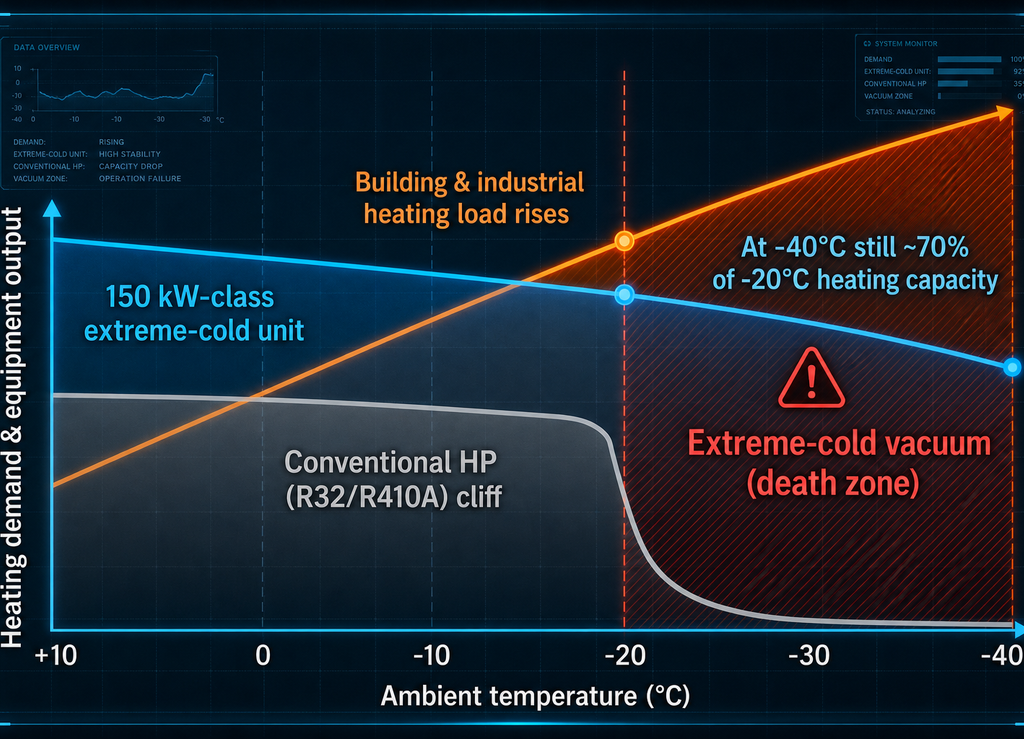
環境溫度從 +10℃ 到 −40℃ 的示意圖:橙色線爲建築與工業熱負荷隨降溫上升;灰色線爲常規熱泵(R32/R410A)在約 −20℃ 以下出力明顯下降;藍色線爲 150kW 級極寒取向機組出力相對平緩,標註在 −40℃ 環溫下仍可約爲 −20℃ 時制熱量的 70%(示意);紅色斜線陰影區表示熱負荷上升而常規機組出力不足的供需缺口帶。
Same story in one plot: load rises toward deep cold while conventional R32/R410A output collapses past ~−20 °C (the hatched “death zone”); a 150 kW-class extreme-cold CO₂-route train stays on the roof of the curve—at −40 °C you still keep roughly 70% of the −20 °C output in this diagram. Explanatory graphic—always tie conclusions to your project rating sheet and test data.

極寒工況下的一組常見對比維度(約 −40℃~−25℃,示意)

Dimension 常規氟系統復疊 (R410A/R32 + R134a) CO₂ 復疊路線示例 (R744 + R515B) 工程上可關注的點
低溫極限下的停機與壽命風險(示意 −40℃) High trip risk
Very low suction density, pressure ratio often 7–8+, discharge >130 °C risks oil carbonization and compressor damage.
Stable envelope
Near −40 °C ambient, CO₂ still holds useful evaporation-side pressure (~10 bar class), system pressure ratio ~3–4, volumetric efficiency >75%, discharge temperature stays controllable.
壓比與排溫往往是壓縮機壽命與可靠性的敏感指標。
Heating fade (−25 to −30 °C) Cliff-edge loss
Capacity drops sharply; COP approaches 1.0 and the plant effectively buys resistance backup heat.
Strong winter curve
At −25 °C COP stays above 2.0; at −30 °C extremes COP still lands ~1.6–1.9 depending on design point.
在不少設計點下,CO₂ 低溫側較高吸氣密度有助於維持容積制熱能力——仍須對照各廠樣本工況與部分負荷曲線。
最高出水溫度 ~50–55 °C
Hard to lift in deep cold; mismatches cast-iron radiator grids in northern China.
~80–90 °C
Low-pressure stage scavenges heat; high-pressure stage rejects at useful glides—80 °C+ hot water is realistic.
若出水溫度能與末端需求對齊,有時可減少大規模末端改造——仍建議個案覈算水力與散熱能力。
環保與合規 High-GWP HFC exposure
e.g. R410A GWP ≈2088; tightening international F-gas style pressure.
Cleaner stack
CO₂ low stage (GWP = 1, ODP 0) plus upper-stage R515B class lower-GWP fluids versus legacy high-GWP-only cascades—better aligned with long-run decarbonization and F-gas trajectories (confirm charge and jurisdiction).
設備生命週期較長時,建議把製冷劑法規趨勢納入採購與改造比選。

商業算賬:建議把初投資、運行費與回本期放在同一張表

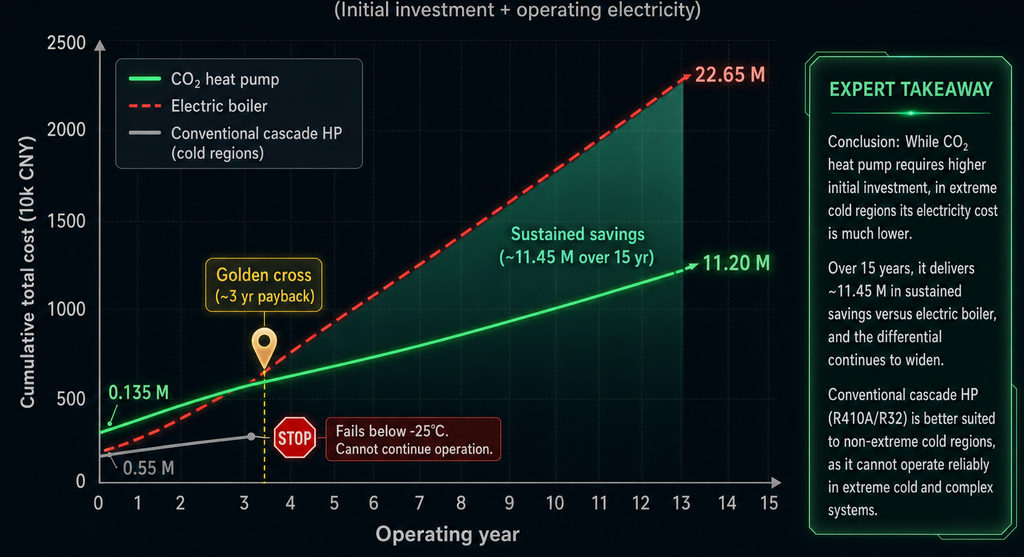
15-year cumulative lifecycle cost in extreme-cold regions (cumulative total)
(Initial equipment CAPEX + cumulative electricity)

Line chart: horizontal axis is operating years 0–15; vertical axis is cumulative total cost in 10⁴ RMB (includes equipment CAPEX plus cumulative electricity). Green line: CO₂ heat pump, high starting point (~1.6M RMB) then moderate slope, about 11.2M RMB at year 15. Red dashed: electric boiler, very low start (~135k RMB) then steep slope, about 22.65M RMB at year 15. Grey: conventional cascade heat pump for cold regions, starts ~550k RMB and is annotated as unable to run in extreme cold (shutdown below about −25 °C) so the curve ends early. A “golden crossover” pin marks where green crosses red near year ~3 (cumulative-cost breakeven vs electric boiler in this scenario).
How to read it: steeper lines mean electricity is piling up faster. In this illustrative case, CO₂’s higher upfront bill is offset by lower operating cost—the crossover with the electric-boiler cumulative curve lands near year 3, and the gap widens afterward. The grey cascade line is a reminder that “cold-region” fluorocarbon cascades may not be operable at your site’s coldest hours. Note: costs are for one representative duty (about 1 steam-ton scale) under stated assumptions—use your tariff, load hours, and contract boundary for real decisions.

若未按極寒工況充分選型與驗收,常規氟系統復疊在低溫窗口可能出現出力與能效不達預期,初投資與運行費容易同時承壓。CO₂ 復疊路線是否更划算,通常建議分項覈算:

  • Industrial-grade bill of materials: a 150 kW-class severe-cold train is real heavy-iron (order-of ~100 HP compressor motor class)—stability exceeds light commercial boxes.
  • Operating cost: at −30 °C near-limit design, useful heat can cost roughly half versus resistive electric or fuel boilers for the same duty—always re-run with project tariffs.
  • ROI on uplift CAPEX: large electricity savings often recover premium equipment in about 1.5–2 years when duty hours align—use site-specific models, not a brochure curve.

系統層面:極寒地區往往更宜考慮「熱泵 + 其它熱源」的多能互補

【工程提醒:留意物理與氣象下限】

空氣源熱泵難以覆蓋所有氣象窗口。內蒙、東北、新疆等地在個別年景可能出現接近或低於 −50℃ 的極端低溫(極端工況下 CO₂ 側亦須關注乾冰三相點附近的運行邊界)。在此類窗口,單純依賴空氣源常常不足以單獨承擔全部負荷,宜在方案階段討論備用或調峯熱源,並結合氣象資料與合同責任邊界約定。

  1. Normal severe winter (−40 °C and warmer): CO₂ heat pump carries base load and captures the efficiency dividend.
  2. Exceptional events (colder than −40 °C): supervisory logic brings gas / electric peaking boilers online—engineered redundancy, not hope.

對公衆用戶與園區管理者而言,更穩妥的敘事往往是:在常見冬季儘量用高能效熱泵降運行費,在極端窗口用備用熱源保供熱底線;具體設備組合與保證條款仍須工程評審與合同約定。

Why “price per kilowatt” for heat pumps rarely lines up

第 3 講 · 商務與標準

Why “price per kilowatt” for heat pumps rarely lines up

People often ask what one kilowatt of heat-pump capacity “costs”. The question is fine—the missing part is which kilowatt, at which outdoor and water conditions, and whether the denominator is thermal output, electrical input, or a trade “horsepower” habit. Here is the shortest checklist.

三種常見「單價」,三種不同分母

  • Money per kW (heating): usually catalog heating capacity at a stated rating point. Ask whether it is a nominal comfort rating or a low-ambient guaranteed output—and at which source/sink temperatures.
  • Money per kcal/h: another heat-power habit; conversion to kW is fixed, but comparability is not—you still need the same rating sheet.
  • Money per “匹” (HP): often a compressor sizing habit or legacy cooling shorthand; it is not a stable, auditable heating kW across brands. Mixed use is where apples become oranges. See Part 7 · Compressor 匹 (HP) for why identical 匹 numbers can still mean different machines.

最大誤區:工況不對齊

用嚴寒或極低溫名義下的「元/kW」去和溫和地區(例如空氣源 +7 °C 一類名義)比單價,像用兩把不同刻度的尺子量同一張桌子:數字看似可比,產品卻不一定同一檔位。

Delivering usable heat at -40 °C outdoor versus +7 °C can imply different compressor families, reinjection/cascade choices, defrost strategy, antifreeze and exchanger sizing—and a different bill of materials. Treat that as a tier change, not a gentle discount. Use the rating table agreed for your project.

即便「紙上同一工況」,也未必公平

Fair comparison needs aligned source/sink temperatures, flow strategy (constant vs variable), whether pumps and auxiliaries are in the input power, how defrost is defined, and whether you compare a single rating point or seasonal/part-load curves. Delivery scope—controls, warranty, installation interface—also belongs outside a naked “per kW” sticker.

給採購與外行一句可帶走的話:先問三個數——在什麼室外/熱源溫度、什麼供水/回水(或熱匯)溫度、要的是名義能力還是某低溫時刻的保證能力——再談單價。

一句話記憶

沒有工況定義、沒有分母定義的「元每千瓦」,和沒有座標系的地圖一樣。

售價與工況:快問快答

「kcal/h 和 kW 換算完不就一樣嗎?」

單位換算固定,工程曲線不固定。-40 °C 與 +7 °C 熱源下的可用制熱與系統形態不是同一條曲線,「同一個 kW」從來不自動等於「同一臺機的任務」。

「銘牌工況我們已對齊,爲什麼報價還差一截?」

Labels can share similar words while differing in test tolerances, auxiliary inclusion, defrost credit, hydraulic assumptions, and what is inside the supplier’s boundary. Treat price as a bundled offer, not a scalar divided by one line on a brochure.

「能不能讓 AI 直接選最便宜的熱泵?」

AI 可協助整理對比;不可替代危害分析、公用工程約束、工質與法規、現場條件與由合格工程師簽署的全生命週期假設。

AI 能完全替代人做製冷/熱泵研發嗎?

第 4 講 · AI 與人的分工

AI 能完全替代人做製冷/熱泵研發嗎?

不能——至少在「真正要緊」的環節上不能。AI 可以加速查資料、對齊表格與起草說明,但製冷與熱泵研發仍依賴人對工況假設、安全邊界、涉密工藝數據以及法律責任鏈的判定;這與第 3 講「售價與工況:快問快答」裏「能不能讓 AI 直接選最便宜的熱泵?」一則的結論一致——可協助整理對比,不可替代危害分析與由合格工程師背書、簽署的工程假設與責任;下文分條說明原因。

1)會自信地胡扯(幻覺)

模型可能給出未經覈對的樣本參數、法規條文或循環細節;若不交叉驗證,會誤導壓縮機選型、安全裕度與試驗方案。人必須用樣本冊、實驗與現場數據做對照,建立可信證據鏈。

2)逢迎用戶(強化錯誤前提)

若前提本身有誤——例如不可能的溫升、對不齊的工況口徑——模型仍可能順着話風說下去。研發更需要獨立質疑與「紅隊」式審查,而不是被迎合。

3)需要敏感數據

真實的工藝曲線、合同條款與運行日誌往往涉密。什麼數據能出防火牆、如何脫敏、誰有權看哪一段熱平衡,仍須由人與制度決定,模型不能代替企業的數據治理。

4)缺乏責任

圖紙、危害分析、質保與事故責任鏈仍落在持證主體與組織身上;AI 輸出不能作爲工程免責依據,聊天記錄更不能等同於「已簽署的工程假設」。

5)讓人變懶

把一階物理覈對全交給工具,會削弱對熱力學邊界與系統集成的直覺;真正扛得住現場的人,仍要能在模型沉默或出錯時,把一條推理從頭到尾做合理性自檢(審視前提是否成立、結論是否與物性/邊界一致)。

一句話記憶

AI 適合整理與起草;涉及安全、數據保管與全生命週期風險時,判定、覈驗與簽字仍須由合格的人來完成。

工業熱泵製冷劑:中、歐、美政策各往哪邊走?

第 5 講 · 工質與政策

工業熱泵製冷劑:中、歐、美政策各往哪邊走?

Comfort HVAC and industrial heat pumps share refrigerant names, but industrial plants often mean higher temperatures, larger charges, and tougher on-site rules. Policy mixes HFC phasedowns, quota-style fluorinated-gas laws, chemical controls (including PFAS debates), and national standards—and the clocks are not synchronized.

This chapter is a brief orientation only. For illustrated chapters on fluid families, safety classes, and China / EU / US policy timelines—and the interactive IIR Table 2 + ASHRAE 34 property table—see the dedicated 製冷劑百科 guide in the Knowledge base.

都說熱泵能降碳,爲什麼實操裏碳排放有時比天然氣鍋爐還高?

第 6 講 · AI 工業熱泵專家

都說熱泵能降碳,爲什麼實操裏碳排放有時比天然氣鍋爐還高?

AI 工業熱泵專家 · 問與答

The contradiction shows up in real project spreadsheets—and it is usually not because heat pumps are physically doomed to be dirtier than gas. More often, teams compare different kinds of carbon, different system boundaries, or a brochure COP against field gas use.

簡單舉例:什麼情況下熱泵更低碳、什麼情況下更高?

Same operating-carbon shortcut as below: heat pump ≈ EFgrid ÷ COPsystem; gas boiler ≈ EFgas ÷ η鍋爐. Illustrative factors: EFgrid ≈ 0.55 kgCO₂/kWhelectricity, EFgas ≈ 0.20 kgCO₂/kWhgas energy, η鍋爐 ≈ 90%. Replace with your audit values.

Heat pump often wins (lower kgCO₂ per kWh of heat)

  • Steady mid-temperature hot water (e.g. 55 °C supply): system COP ≈ 3.5 → 0.55 ÷ 3.5 ≈ 0.16 kgCO₂/kWhheat. Gas: 0.20 ÷ 0.9 ≈ 0.22 → heat pump lower.
  • Process waste heat as source, well-matched load: system COP ≈ 4.0 → 0.55 ÷ 4 ≈ 0.14 vs gas ≈ 0.22 → margin widens; coupling matters more than a cold outdoor rating.
  • Green power or low-carbon PPA: effective EFgrid ≈ 0.10 (illustrative) and COP ≈ 3 → ≈ 0.03 vs gas ≈ 0.22 → electrified heat wins clearly on operating carbon (scope depends on your reporting rules).

燃氣鍋爐往往更低(熱泵顯得「更髒」)

  • High-temperature steam heat pump: system COP ≈ 1.3 → 0.55 ÷ 1.3 ≈ 0.42 kgCO₂/kWhheat vs gas ≈ 0.22 → gas lower; common when ΔT is large and auxiliaries are heavy.
  • Cold-climate air source + defrost + electric backup: annual system COP ≈ 2.0 → 0.55 ÷ 2 ≈ 0.28 vs condensing gas ≈ 0.20–0.22 → gas can edge ahead even before counting backup electricity.
  • “Brochure COP” vs field reality: spreadsheet uses COP 4 at +7 °C (≈ 0.14) but plant runs at COP 1.8 (≈ 0.31)—gas looks worse on paper, better in meters.

Quick check (illustrative factors only): breakeven system COP ≈ EFgrid ÷ (EFgas ÷ η) ≈ 0.55 ÷ 0.22 ≈ 2.5. Above that, heat pump operating carbon tends to beat efficient gas; below it, gas can win—exact crossover depends on your real EF and η.

1)先對齊「碳」指什麼

Human version: boiler carbon is in the chimney; heat-pump carbon is on the meter and in the grid factor—if you do not line up the ledger, you are not comparing the same thing.
Engineering version: Scope 1 (site direct): gas boilers emit combustion CO₂; heat pumps have no stack—chimney-only accounting flatters heat pumps. Operating carbon: electricity × grid emission factor—where most heat-pump footprints live. LCA / corporate inventory: may add manufacturing, refrigerant leakage (GWP), logistics; “gas fuel only” is a different boundary.

2)電網排放因子:一票否決項

Human version: a heat pump is only as clean as the power behind the plug—and the spreadsheet factor you pick.
Engineering version: Average vs marginal factors, regional vs national defaults, and outdated yearbooks all move results. Rough operating carbon intensity per kWh of useful heat: heat pump ≈ EFgrid / COPsystem; gas boiler ≈ EFgas / η鍋爐 (pumps, fans, defrost, standby belong in COPsystem). Low COPsystem or high EFgrid—common with large industrial ΔT—can make heat pumps lose to efficient gas. Use the factor required by your carbon audit or contract, not a generic internet number.

3) Field COP is often far below catalog COP

Human version: the COP on the brochure is not the COP your carbon spreadsheet should use.
Engineering version: Large temperature lift (steam / high-temperature water), part load, cycling, defrost, and antifreeze loops cut real performance—see 第 2 講 · 認知 and 第 3 講 · 商務與標準. Auxiliary power (source pumps, towers, controls, trace heat) is often excluded from “compressor COP”. Matching a +7 °C comfort nameplate to a 120 °C steam heat pump’s annual curve will distort carbon results.

4)系統邊界不公平

鍋爐側常只算「爐體效率」;熱泵側若只算壓縮機,不算源側換熱、輸配泵、蓄熱、備用電鍋爐/電輔熱、冷卻塔與風機——就會出現設備 COP 好看、系統碳卻很差。

5)運行策略與電源結構

Grey grid without green power or PPA caps electrified heat. Long hours on electric backup or gas peaking in cold windows load high-carbon energy into the heat-pump total. Condensing gas at high load factor vs a heat pump at low load compares a best boiler hour to a worst heat-pump window. For policy context on assessment, see industrial heat pump policies.

6)公平比碳:工程檢查清單

在宣佈誰贏之前,請用同一週期、同一邊界、同一套因子覈對:

  • Same period: full year or heating season; same useful-heat metering boundary.
  • Same metric: kgCO₂/kWhheat vs tCO₂/year—and whether auxiliaries are in the denominator.
  • Grid factor: region, year, average vs marginal—per authority or your carbon reporting guide.
  • Heat pump: weighted system COP (or SP + COP for steam units—see standards quick reference).
  • Gas boiler: measured or contract η; include condensing / flue-gas recovery if present.
  • Include peaking: backup boiler, electric auxiliaries, standby, defrost energy.
  • Hours & load factor: match process reality—do not extrapolate a lab single point across a year.
  • Compliance: if carbon assets or local assessment apply, match the reporting boundary (see policy map).

一句話記憶

A heat pump is not born green—greenness ≈ how clean the grid is × how high system COP is × whether the boundary is complete.

For project numbers, use the Heat Pump Benefit Analyzer with aligned boundaries; cross-check steam metrics on the industrial heat pump standards page where relevant.

比碳:快問快答

「熱泵現場零排放,爲什麼報告裏比燃氣鍋爐還髒?」

Indirect emissions from electricity—and often omitted auxiliaries—are in the total. Stack zero ≠ carbon zero.

「COP 2,是不是一定比鍋爐低碳?」

Not always. It depends on EFgrid, boiler η, boundary, and hours. In coal-heavy grids or low system COP, gas can win on operating carbon intensity.

「怎樣讓熱泵在碳上真正贏過鍋爐?」

Improve weighted system COP and process coupling, cut auxiliaries and peaking, add green power or storage, and compare with audited factors—not AI-invented grid or COP values.

排放因子與碳盤查口徑因地區與報告制度而異;本篇爲工程科普取向,不構成碳覈查或法律意見。

Refrigeration/heat-pump compressor “匹” (HP): what it means—and what it does not

第 7 講 · 製冷熱泵專家

Refrigeration/heat-pump compressor “匹” (HP): what it means—and what it does not

製冷熱泵專家 · 問與答

In the trade, “60P” sounds like a fixed size. In engineering, it is often three different things at once—and the rating temperature you never asked about can move real delivered kW by a large margin. This chapter untangles 匹 vs kW, refrigerant and operating conditions, what national standards actually say, and why two “same horsepower” quotes are not the same machine.

案例:都叫 60P,爲什麼一家貴很多?

A common field story: two suppliers both offer 60P air-source heat pumps. One price looks “expensive”; the other looks like a bargain. After installation, the owner finds the cheaper box was rated at +7 °C outdoor air and moderate leaving-water temperature, while the premium unit was sized for −12 °C ambient and higher supply water—different hardware tiers, not the same product mis-priced. Numbers below are illustrative; always use each vendor’s rating sheet.

方案 A — 偏嚴寒標定(價高往往有理由)

  • Label: 60P
  • Outdoor / source: −12 °C air (low-ambient rating point)
  • Supply water: ~45 °C class (higher lift)
  • Typical stack: heavier compressor map, reinjection or cascade more likely, larger evaporator, stronger defrost—real BOM tier above mild-climate boxes

方案 B — 溫和地區標定(標價低,任務檔不同)

  • Label: 60P
  • Outdoor / source: +7 °C air (comfort-style rating point)
  • Supply water: ~35–40 °C (lower lift)
  • Typical stack: single-stage comfort envelope, nameplate kW looks generous at the mild point—may fade sharply at the owner’s real winter hour

Same “60P” label ≠ same heating kW at your site. Higher price is not automatically margin; lower price is not automatically a steal—often it is a different rating tier. See also 第 3 講 · 商務與標準 (“two rulers, one table”).

1) Three “匹” habits—do not mix them

Motor / frame class: OEM catalogs (Bitzer, Dorin, etc.) often use HP for motor power or product series—not guaranteed system heating kW.
Cooling-capacity shorthand: in Chinese HVAC trade, 1 匹 ≈ 2.5 kW cooling at a historical comfort rating point—already refrigerant- and condition-dependent.
Marketing label: “60P” on a brochure may summarize none of the above consistently. Before comparing ¥/匹, ask which definition the seller uses.

2)與工況強相關

For the same compressor displacement, changing evaporation and condensation temperatures shifts mass flow, volumetric efficiency, and power—so heating/cooling kW moves. There is no “匹” detached from source temperature, sink temperature, and part-load point. −12 °C vs +7 °C outdoor air is not a small correction; it can change compressor family, reinjection/cascade, defrost, and heat-exchanger area.

3)與製冷劑強相關

Switching fluid—R134a, R410A, R32, R515B, R744, ammonia, etc.—changes suction density, pressure ratio, and discharge temperature. The same frame “HP class” therefore maps to different kW on the performance map. Cross-brand 匹 comparisons without aligned refrigerant and rating point are unreliable.

4)國標認什麼、不認什麼

Chinese product and test standards express nominal capacity in kW at specified rating conditions—not “匹” as the legal unit. Examples on this site’s standards quick reference: GB/T 18430.1 (industrial/commercial water chilling & heat pump packages), GB/T 25127.1 (low-ambient air-source, cold-climate oriented), GB/T 10870 (performance test methods referenced by those families). Procurement contracts should cite kW + outdoor/source temp + supply/return water (or sink) temp, not 匹 alone.

5)公平比價清單(與第 3 講互補)

Before ¥/匹 or ¥/kW, align:

  • Source temperature: outdoor air, water, or waste-heat stream at the rating point.
  • Sink temperature: supply/return water or process temperature.
  • Nominal vs guaranteed: catalog nameplate or minimum output at a cold hour.
  • 製冷劑 and whether heating or cooling duty is quoted.
  • Auxiliaries: pumps, fans, defrost energy inside input power or not.
  • Curve vs single point: part-load/seasonal performance, not one brochure line.

一句話記憶

“匹” is a spoken label; kW @ stated conditions is engineering language. Comparing 匹 without aligned rating points is ordering without units.

For ¥/kW pitfalls and boundary issues, read 第 3 講 · 商務與標準; for GB/T families and test points, use the industrial heat pump standards quick reference. For machine families, maps, and oil return, see the compressor knowledge guide.

壓縮機匹數:快問快答

“How many kW is 1 匹?”

Trade habit often uses ~2.5 kW cooling at a comfort rating point—but that is not a universal heating kW. For procurement, demand the vendor’s kW table at your source/sink temperatures, not a mental conversion factor.

「樣本寫 60P,國標認嗎?」

Standards recognize kW at defined test conditions (see GB/T 18430.1, GB/T 25127.1, GB/T 10870). “匹” remains market shorthand. Contracts should state kW, ambient/source temperature, and water temperatures—not 匹 alone.

“Can we size across brands using 匹?”

只能作粗篩。定標須對齊工質、蒸發/冷凝(或空氣/水)溫度、制熱/製冷應用,以及輔機是否在供貨邊界內。

「這和第 3 講元/kW 什麼關係?」

Part 3 explains why denominators misalign. This chapter explains why “匹” is one of the most confusing denominators—and why two identical 匹 numbers can imply different machines and prices.

各廠性能圖、標準版本與項目質保條款因案而異;本篇爲面向採購與集成商的工程科普,不能替代型式試驗報告或簽署的技術規格書。
氣電比與臨界 COP:熱泵 + 燃氣鍋爐怎樣耦合才省錢?

第 8 講 · 耦合與運行經濟

氣電比與臨界 COP:熱泵 + 燃氣鍋爐怎樣耦合才省錢?

耦合與運行經濟 · 問與答

Human version: when gas is cheap relative to electricity, a heat pump must work harder (higher COP) to beat the boiler on the bill—and in cold or defrost hours it often cannot, so a coupled system makes sense.
Engineering version: define the gas–electric price ratio r = Pgas (¥/m³) ÷ Pelec (¥/kWh), align unit heat costs, and dispatch to whichever source wins at each hour’s system COP. This chapter is about operating money, not carbon—see Part 6 · Carbon for the parallel carbon breakeven.

氣電比與臨界 COP* 怎麼算

Use consistent units. Natural gas lower heating value LHV ≈ 9.87 kWh/m³ (≈ 8600 kcal/m³)—confirm with your gas contract. This worked example is not a contract calorific value; compare published ranges on the energy-factor reference. Boiler efficiency η鍋爐 is the useful-heat fraction (include condensing recovery if present).

  • Gas–electric ratio: r = Pgas ÷ Pelec (¥/m³ per ¥/kWh).
  • Unit heat cost — gas boiler: Cgas = Pgas ÷ (η鍋爐 × LHV) ¥/kWhheat.
  • Unit heat cost — heat pump: Chp = Pelec ÷ COPsystem ¥/kWhheat.
  • Breakeven COP*: COP* = Pelec × η鍋爐 × LHV ÷ Pgas = η鍋爐 × LHV ÷ r. Run the heat pump when COPsystem > COP* (and capacity allows); otherwise prefer gas.

Intuition: higher r (gas expensive vs electricity) → lower COP* → heat pump wins more hours. COPsystem moves with outdoor temperature, defrost, and part load—coupling is about picking the cheaper source hour by hour.

Do not confuse COP* with Part 6’s carbon breakeven

Part 6 uses grid and gas emission factors (kgCO₂/kWh)—breakeven COPcarbon ≈ EFgrid ÷ (EFgas ÷ η). With illustrative factors that is often ~2.5. This chapter’s COP* uses tariffs. Example: Pelec = 0.6 ¥/kWh, Pgas = 2.2 ¥/m³, η = 90% → r ≈ 3.67, COP* ≈ 2.4—similar number, different ledger. A scheme can be cheap but carbon-heavy, or clean but expensive.

三個示意算例(建築 / 區域供暖)

Numbers below are illustrative only—replace with contract gas price, your tariff structure, measured η, and field COP curves.

算例 A — 費用偏向熱泵

Pelec = 0.6 ¥/kWh, Pgas = 2.5 ¥/m³, η = 90%, winter average COPsystem = 3.2 → r = 4.17, COP* ≈ 2.13. 3.2 > 2.13 → prefer heat pump in those hours.

算例 B — 該窗口燃氣更省

Pelec = 0.8 ¥/kWh, Pgas = 2.0 ¥/m³, COPsystem = 1.8 after defrost → r = 2.5, COP* ≈ 3.55. 1.8 < 3.55 → let gas carry this window.

算例 C — 爲何混合優於「全熱泵」或「全燃氣」

Same season: ~70% of hours COPsystem > COP* (heat pump), ~30% below (boiler for defrost, peak load, or cold ambient). Hybrid dispatch is not a compromise—it is marginal-cost routing per hour.

三種常見耦合形態

1)並聯混供(同一供水母管)

Existing gas boiler + new air-source heat pump on the same heating main. When COPsystem > COP* and the heat pump is not maxed out → heat pump first; boiler fills the gap.

2)熱泵主供 + 燃氣調峯

Typical in cold climates: heat pump covers normal hours; boiler covers extreme ambient, heavy defrost, and peak load—same engineering logic as Part 1 · CO₂ cascade backup, without requiring CO₂ hardware.

3)分時調度(峯谷電價)

With valley electricity, run the heat pump hard in cheap hours (buffer tank or mild oversupply). In peak-price hours, run heat pump only if COPsystem still beats COP* at the peak tariff; otherwise shift to gas.

Industrial boundary note: high-temperature or steam duty pushes COPsystem down and COP* up—coupling and thermal storage matter more; this chapter focuses on building / district hot-water heating.

1)氣電比不是常數

Tiered gas contracts, seasonal heating tariffs, commercial peak/valley electricity, and demand charges all move <em>r</em> and COP* through the year. Size dispatch logic for <strong>your bill structure</strong>, not a single national average.

2) COP<sub>system</sub> ≠ catalog COP

Outdoor temperature, supply water setpoint, defrost, part load, and auxiliary power (fans, pumps, controls) set the real denominator—see 第 2 講 · 認知, Part 3 · Pricing, and Part 7 · Compressor HP. Dispatch on measured or simulated hourly COP, not a +7 °C brochure line.

3)容量與舒適度約束選擇

Even when COP<sub>system</sub> &gt; COP*, a undersized heat pump must call the boiler for peak load. COP* tells you <strong>which fuel is cheaper</strong>; capacity tells you <strong>who can deliver the kW</strong>.

4)可靠性與經濟性要分開寫進控制策略

Boiler hours in extreme cold may be poor economics yet good engineering—backup is insurance, not “wasted gas”. Separate <strong>minimum reliability</strong> rules from <strong>economic dispatch</strong> in the control spec.

5)對齊系統邊界

Include circulation pumps, flue losses, and condensing recovery in η<sub>鍋爐</sub>; include source-side fans, defrost, and standby in COP<sub>system</sub>. Otherwise COP* looks favorable to the side with the narrower boundary.

6)集成商 / 業主清單

在寫調度邏輯或承諾「全年熱泵」之前:

  • Contract gas price (¥/m³) and LHV basis.
  • 工業電價—flat vs peak/valley; demand charges if any.
  • Boiler η at representative load (condensing on/off).
  • Heat pump COP curve vs outdoor temp and supply water—annual weighted, not one rating point.
  • 峯值熱負荷 vs heat pump nameplate at design ambient.
  • Control modes: parallel, peaking, TOU—written in the O&M manual.

一句話記憶

Coupling is hourly marginal cost: compute COP* from r and η; run the heat pump when COPsystem beats COP* and capacity allows—otherwise let the boiler work.

For project economics, use the Heat Pump Benefit Analyzer with aligned tariffs and COP curves—not a single brochure point. Carbon crossover is in Part 6; extreme-cold peaking context in Part 1.

氣電比與耦合:快問快答

「全國有一個固定臨界 COP 能套用嗎?」

No. COP* moves with local <em>r</em>, boiler η, and sometimes hourly tariffs. Recompute per site and season.

「COP 2 一定比氣貴吧?」

Not always—it depends on r. Low gas price or high electricity can push COP* above 2; that is money, not the same as Part 6’s carbon breakeven.

「AI 能自動選熱泵還是鍋爐嗎?」

AI can organize hourly COP and tariff tables; contract gas price, tariff riders, and signed COP test data still need qualified human review before control logic goes live.

「冬天全燒氣不是更簡單嗎?」

算過 COP* 後,許多地區大部分小時仍偏向熱泵;混合方案把這些小時喫滿,同時保留鍋爐應對峯值與寒潮。

氣價、電價、計費規則與實測效率因合同與現場而異;文中示意 LHV 與 η 不能替代可研或審計依據。