熱泵基礎 · 循環
製冷與熱泵循環導讀
Before you pick a compressor or refrigerant, you need a cycle family. This illustrated guide maps ideal references (reverse Carnot), gas cycles (reverse Brayton), the industry workhorse (subcritical vapor compression) and its upgrades, transcritical CO₂, absorption, and open steam/MVR—with flow, P–h, and T–s reading tips. Pair with 基礎第 2 講 (why ΔT forces variants) and the engineering toolbox.
0 · 循環族譜與讀圖約定
循環是系統的語法,部件是詞彙——兩者缺一不可。先對齊族譜與讀圖方式,後面各章才說同一種話。
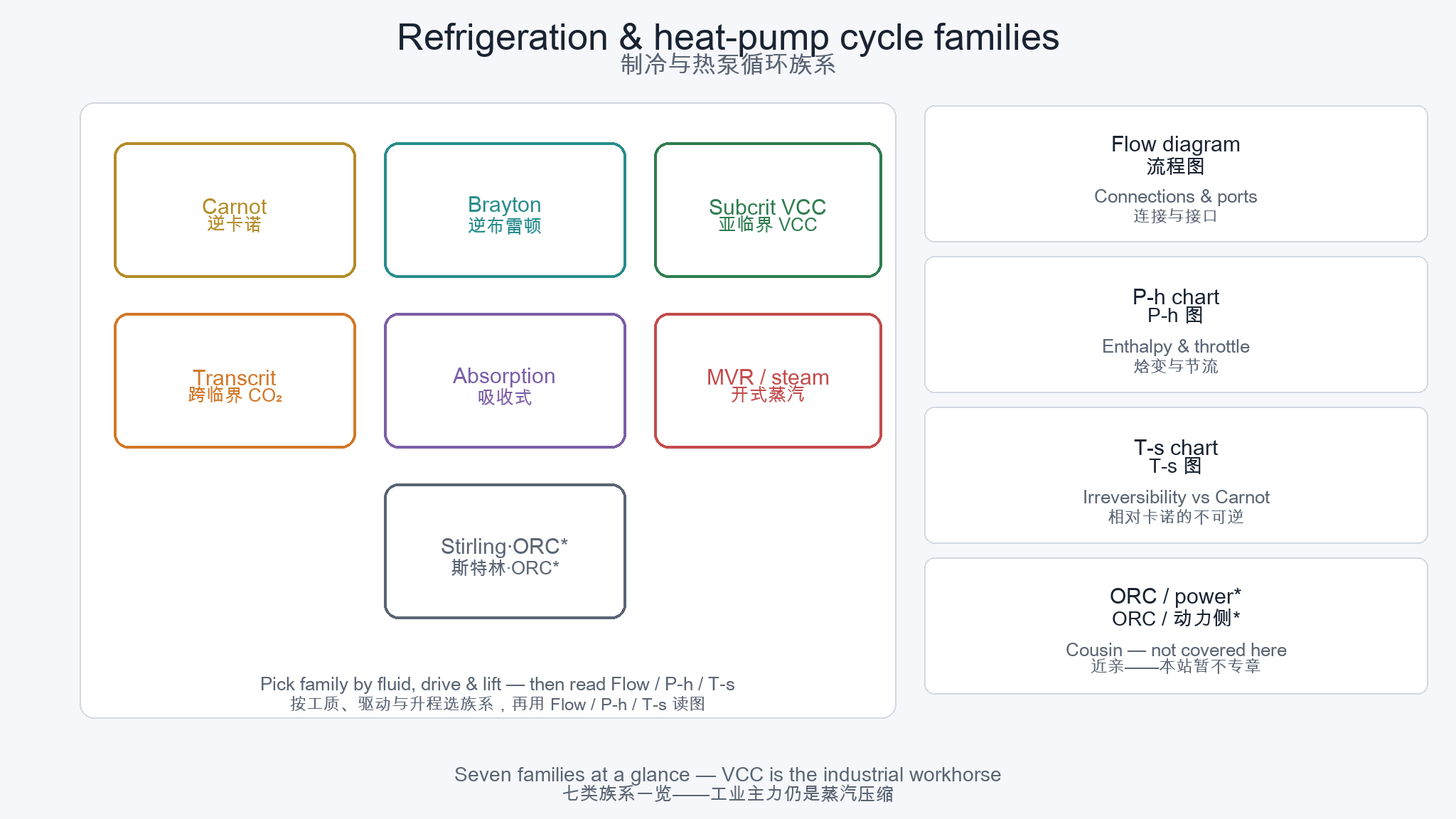
流程圖
Shows what connects to what: compressors, heat exchangers, expanders/valves, vessels. Best for plant conversation and P&ID intuition.
P–h 圖
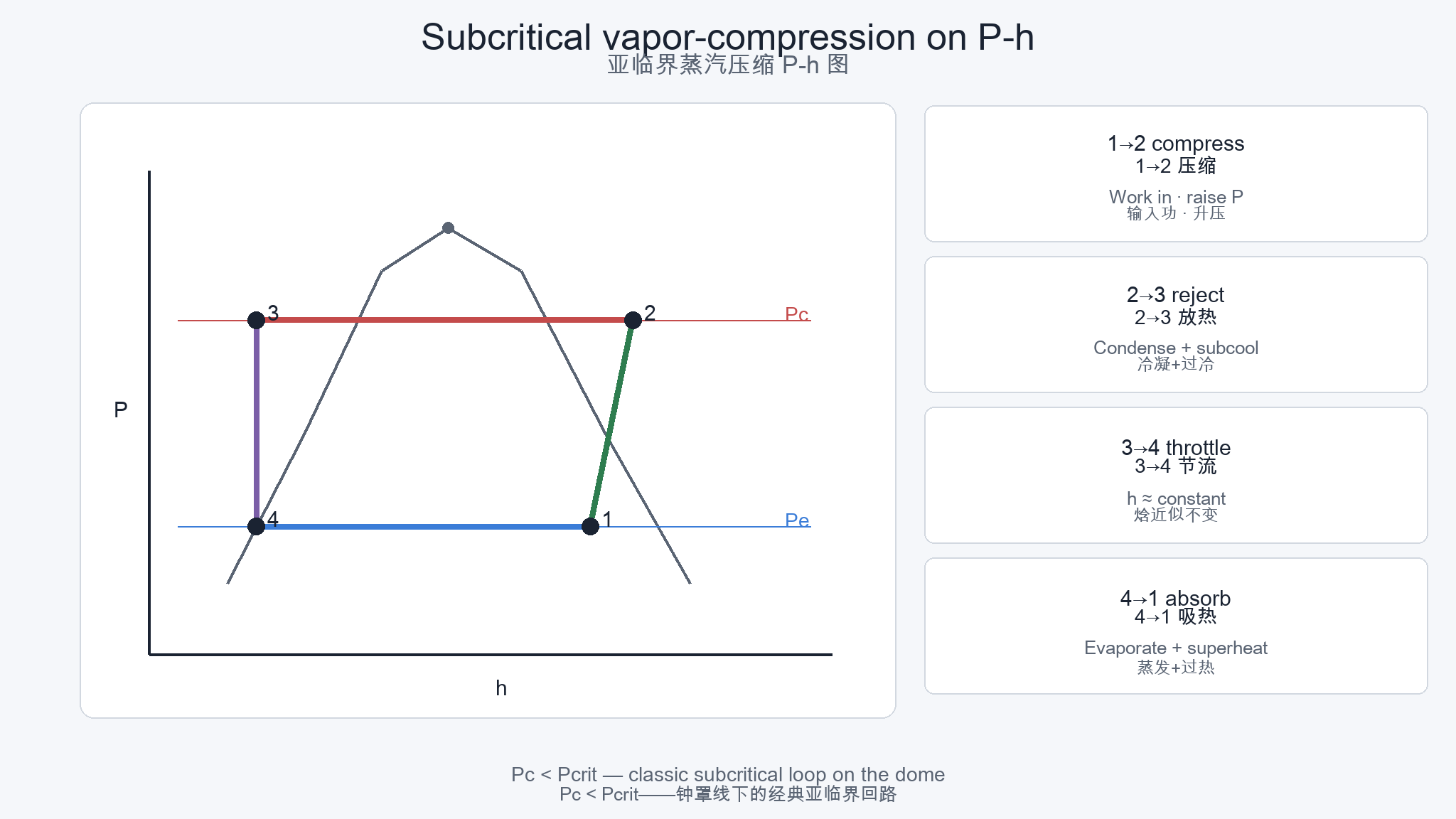
Pressure vs enthalpy. Read capacity and power as Δh, see throttle as nearly vertical (h≈const), and spot subcooling / superheat. Default language for VCC and CO₂ packs. Check a single-point state on the 物性計算.
T–s 圖
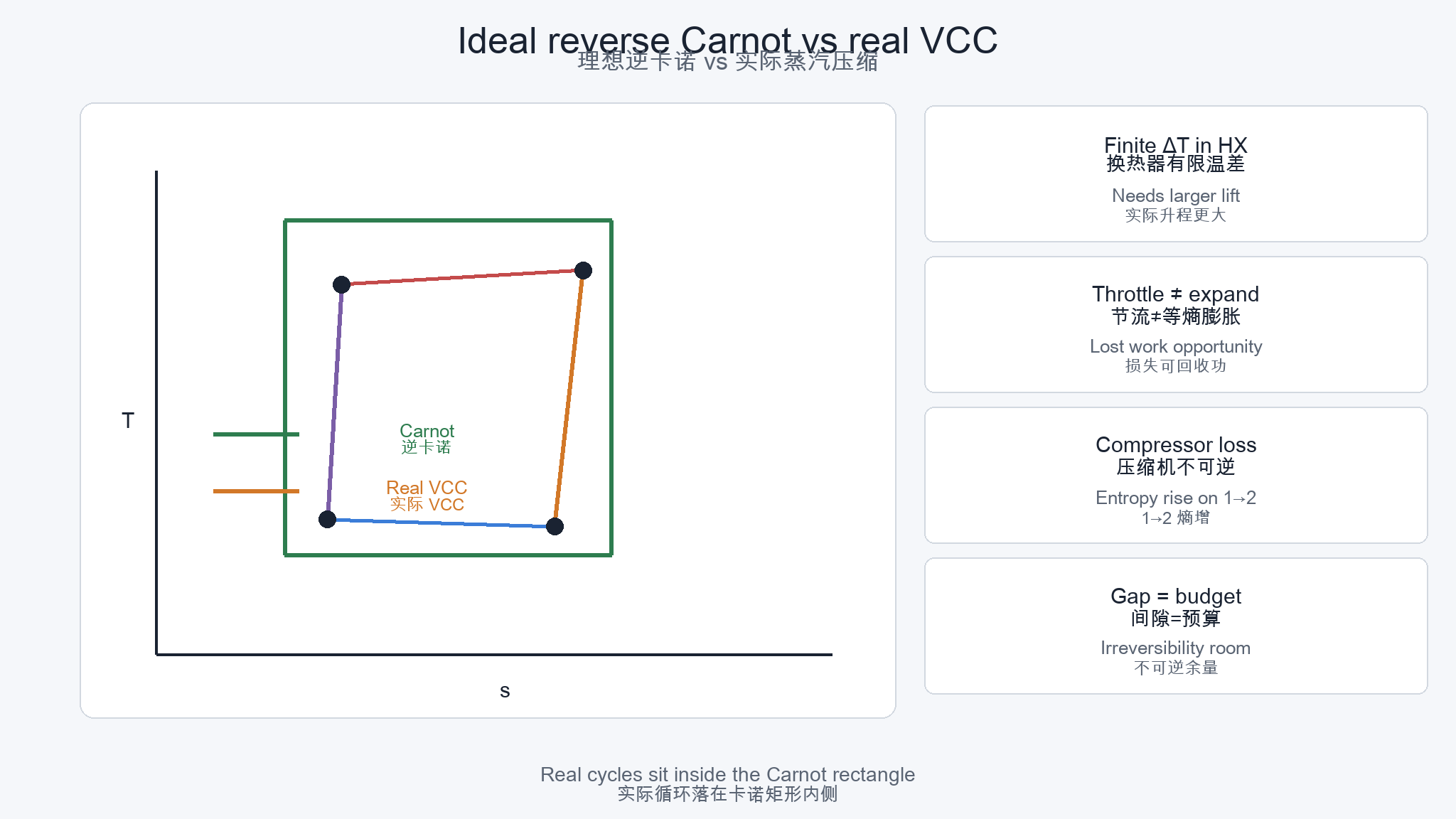
Temperature vs entropy. Best for Carnot distance and irreversibility—why real cycles cannot fill the ideal rectangle.
同一物理,不同「有用側」
A chiller and a heat pump can share the same vapor-compression loop. Cooling counts evaporator kW; heating counts condenser (or gas-cooler) kW. Always state source and sink.
1 · 逆卡諾——理論上限
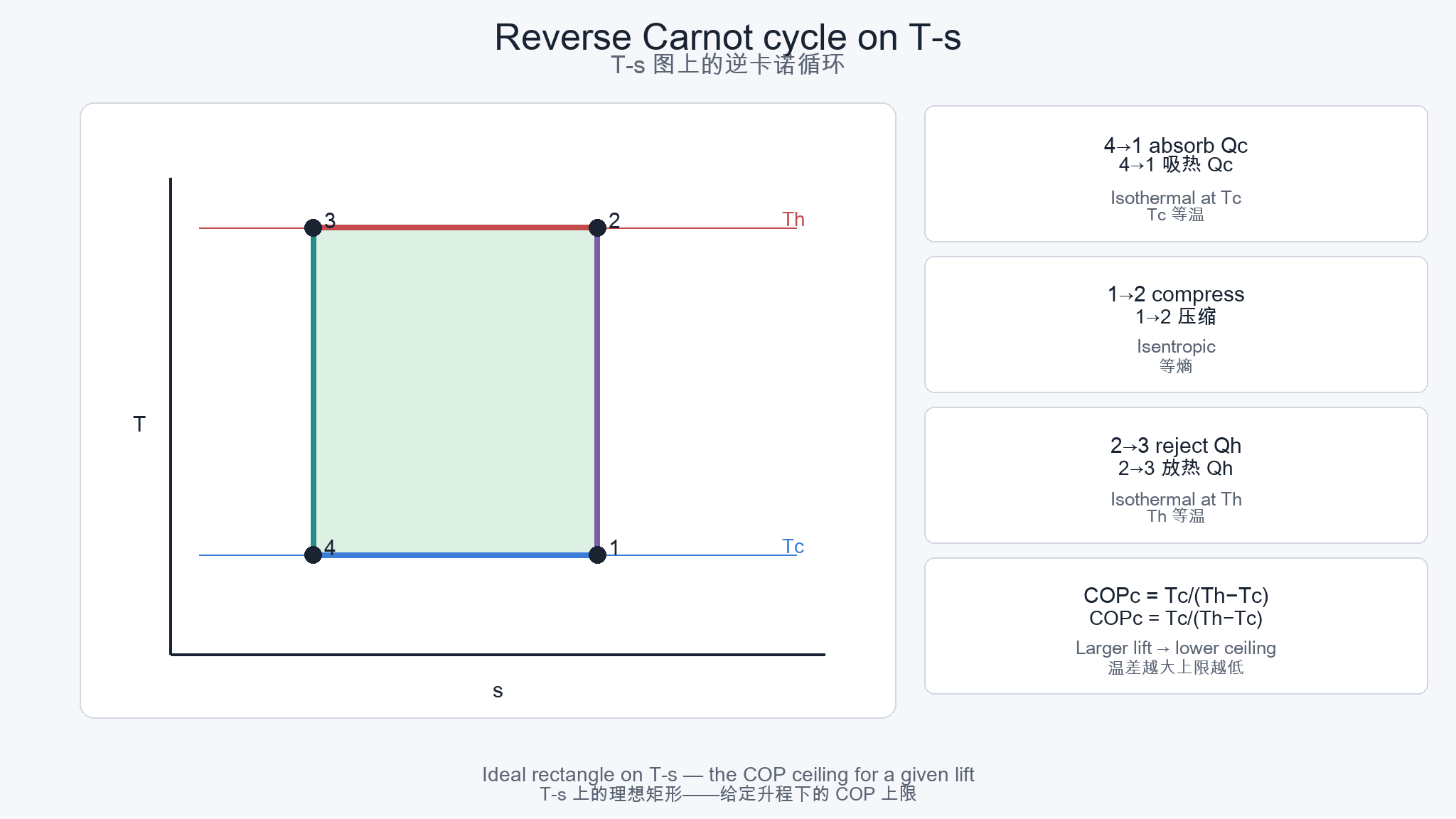
Reverse Carnot is not a machine you buy. It is the upper bound on COP for given cold and hot temperatures—and the reason large lift forces different real cycles.
COP 直覺
Cooling: COPc = Tc / (Th − Tc). Heating: COPh = Th / (Th − Tc) (absolute temperatures). Larger lift → lower ceiling—no marketing brochure can repeal this.
爲何鍋爐顯得「簡單」
A boiler makes heat; it does not fight a Carnot gap between source and sink. Heat pumps move heat across that gap—see 第 2 講 · 認知.
理想循環的工程用法
Use Carnot as a sanity check: if a quoted COP sits above the reverse-Carnot limit for your Tc/Th, the boundary conditions are wrong—not “better technology.”
2 · 逆布雷頓——氣體循環、無相變
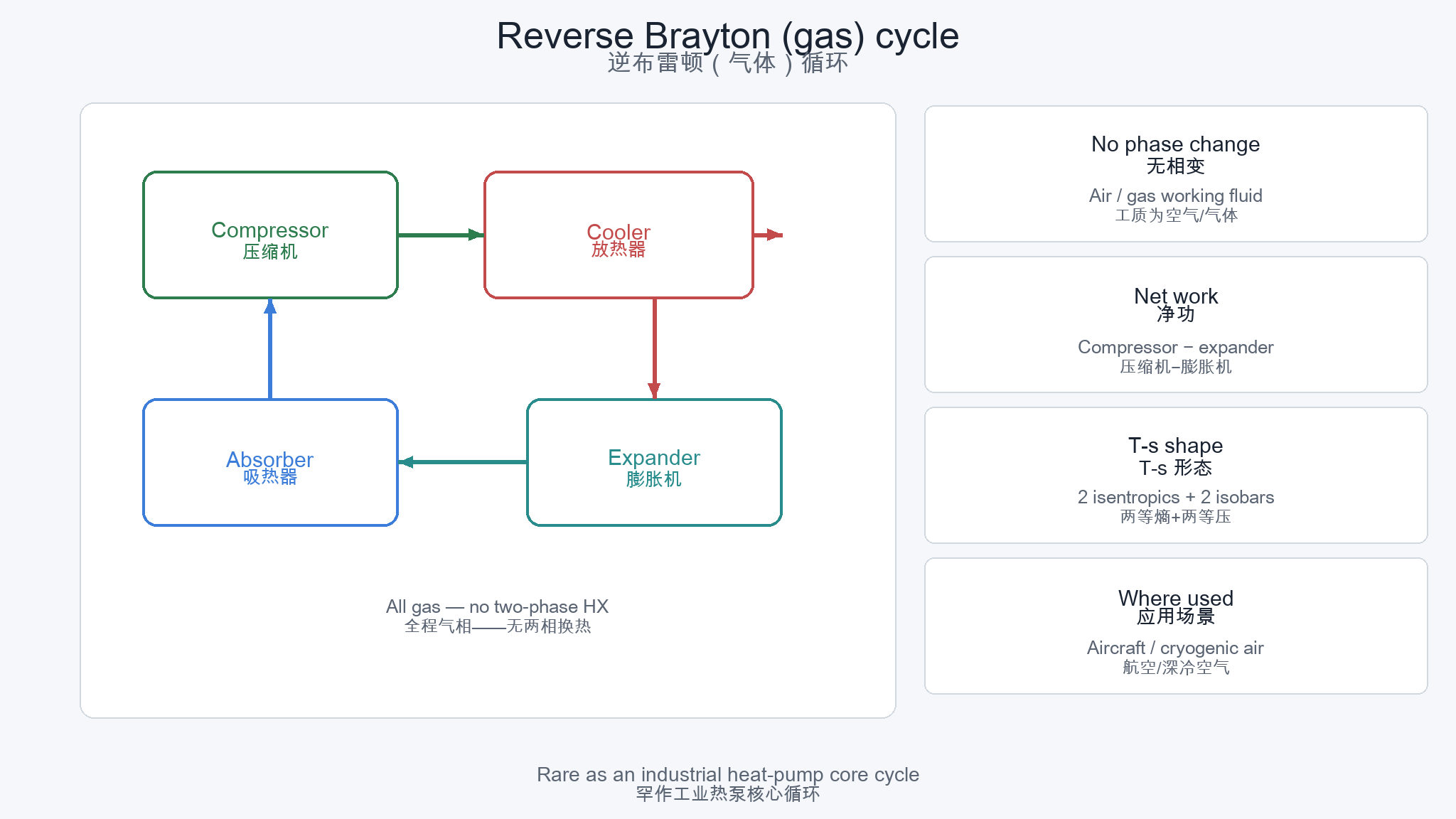
Reverse Brayton (Bell-Coleman / air cycle) stays in the gas phase: compressor → heat rejector → expander → heat absorber. No condenser or evaporator two-phase.
常見場景
Aircraft environmental control, some cryogenic / air-cycle coolers, specialty gas processes. Occasional R&D mentions next to Stirling for exotic HTHP paths—not the industrial HP default.
爲何難成工業熱泵主力
無潛熱則同樣冷量需要更大流量與換熱面積,比功與體積上升快。有相變的蒸汽壓縮通常在硬件密度上更佔優。
勿與正布雷頓混淆
Gas turbines run the forward Brayton cycle (produce work). Reverse Brayton consumes work to move heat. Same family name, opposite purpose.
3 · 亞臨界蒸汽壓縮——行業主力
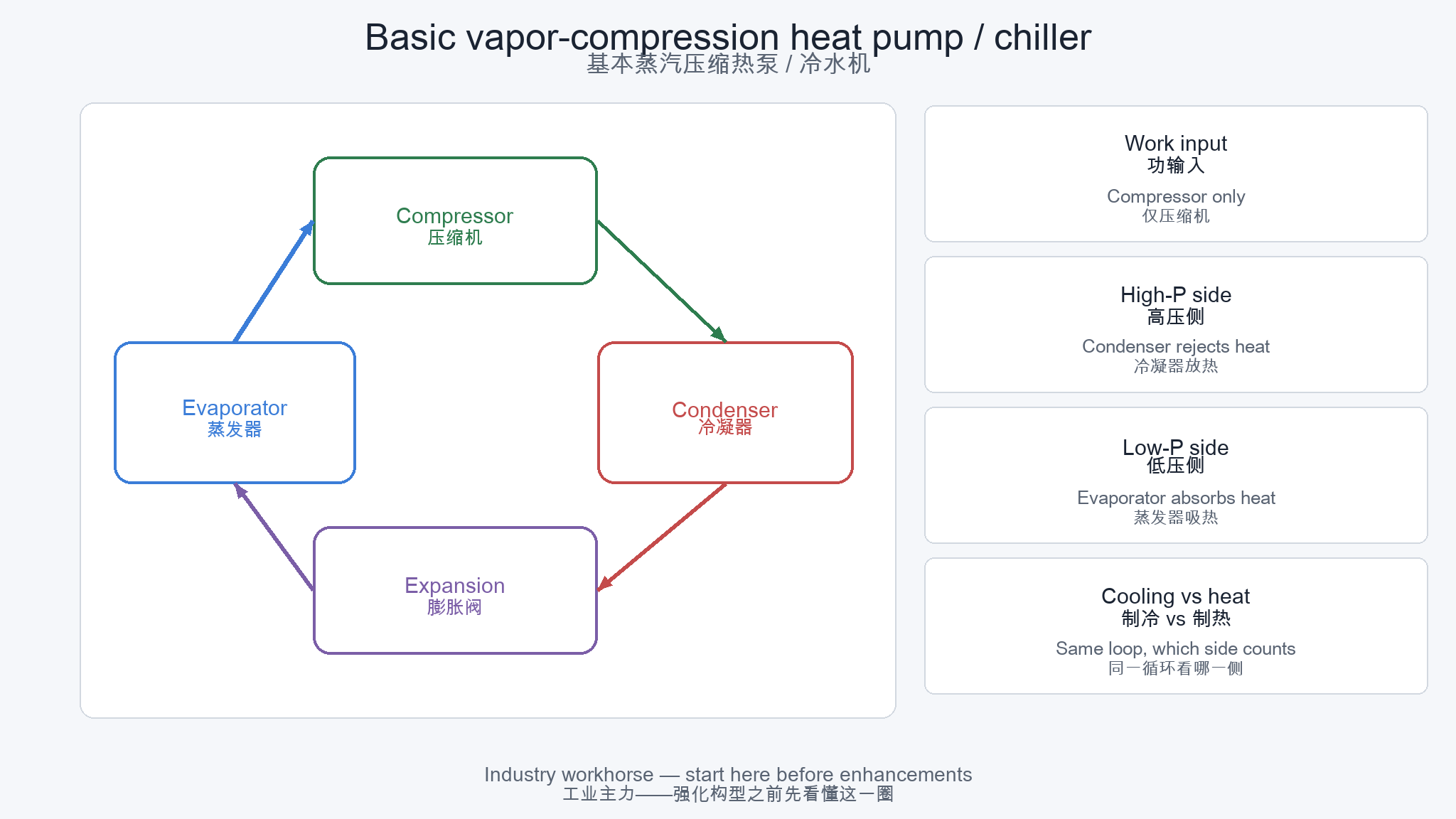
Most chillers and heat pumps you meet are subcritical vapor-compression cycles (VCC): evaporate → compress → condense → throttle. Pressures stay below the fluid’s critical pressure on the high side.
四過程 ↔ 四類硬件
1→2 compression (compressor) · 2→3 heat rejection (condenser / desuperheat + subcool) · 3→4 expansion (valve or orifice) · 4→1 heat absorption (evaporator). Homepage config (a) Basic VCHP.
P–h 上要看什麼
吸氣過熱、閥前過冷、壓縮機偏離等熵、節流「扔掉」多少焓——這些差距推動經濟器與分級。
制熱與製冷是記賬差異
The loop is the same. Contracts must say whether kW means evaporator or condenser—and at which water/air temperatures. See also Part 3 · Pricing.
單級何時撞牆
大 ΔT 抬高壓比與排氣溫度。油、密封與性能圖先於「宣傳 COP」失效——進入第 4 章強化形態。
4 · 強化形態——經濟器、雙級、復疊
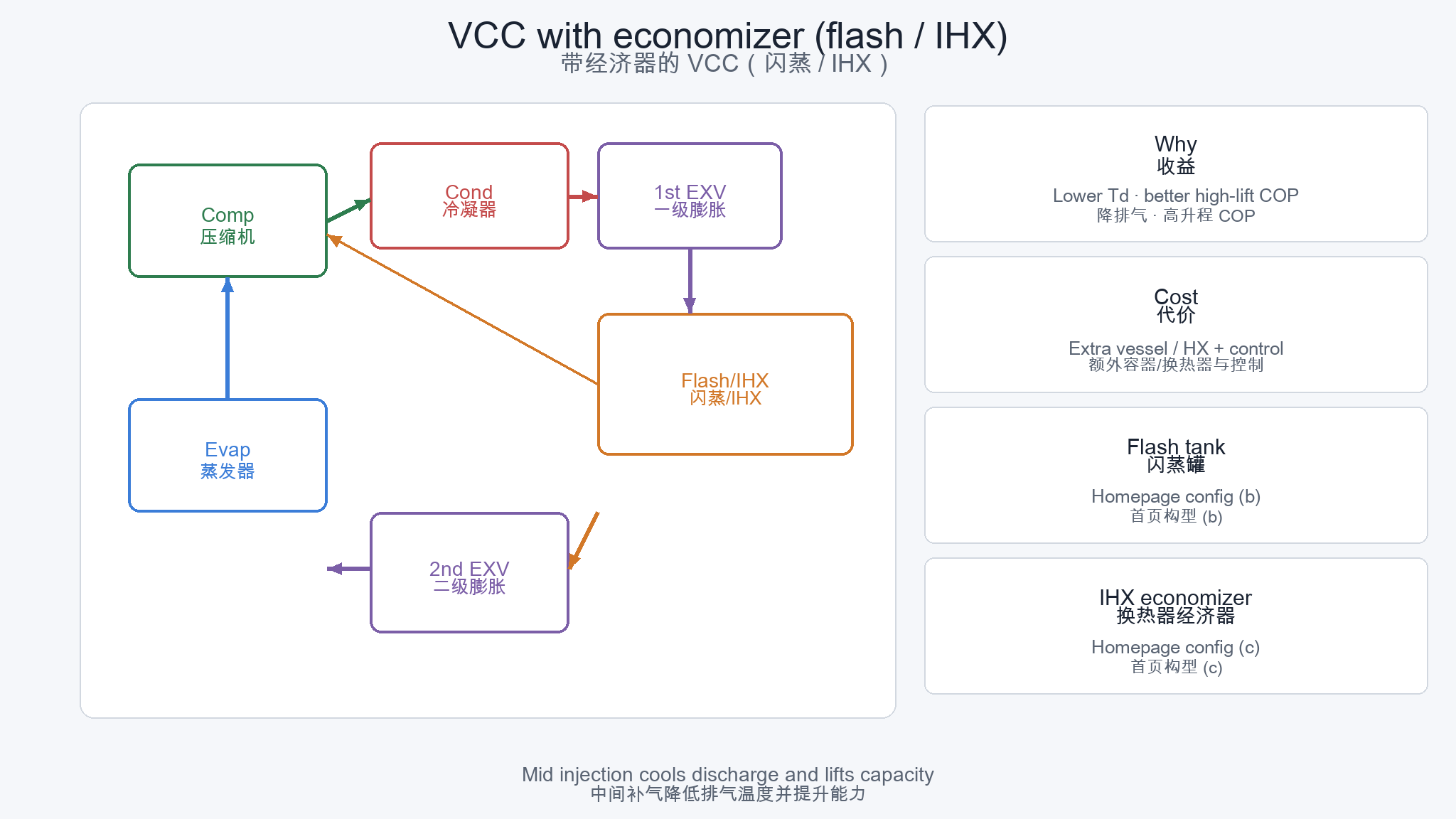
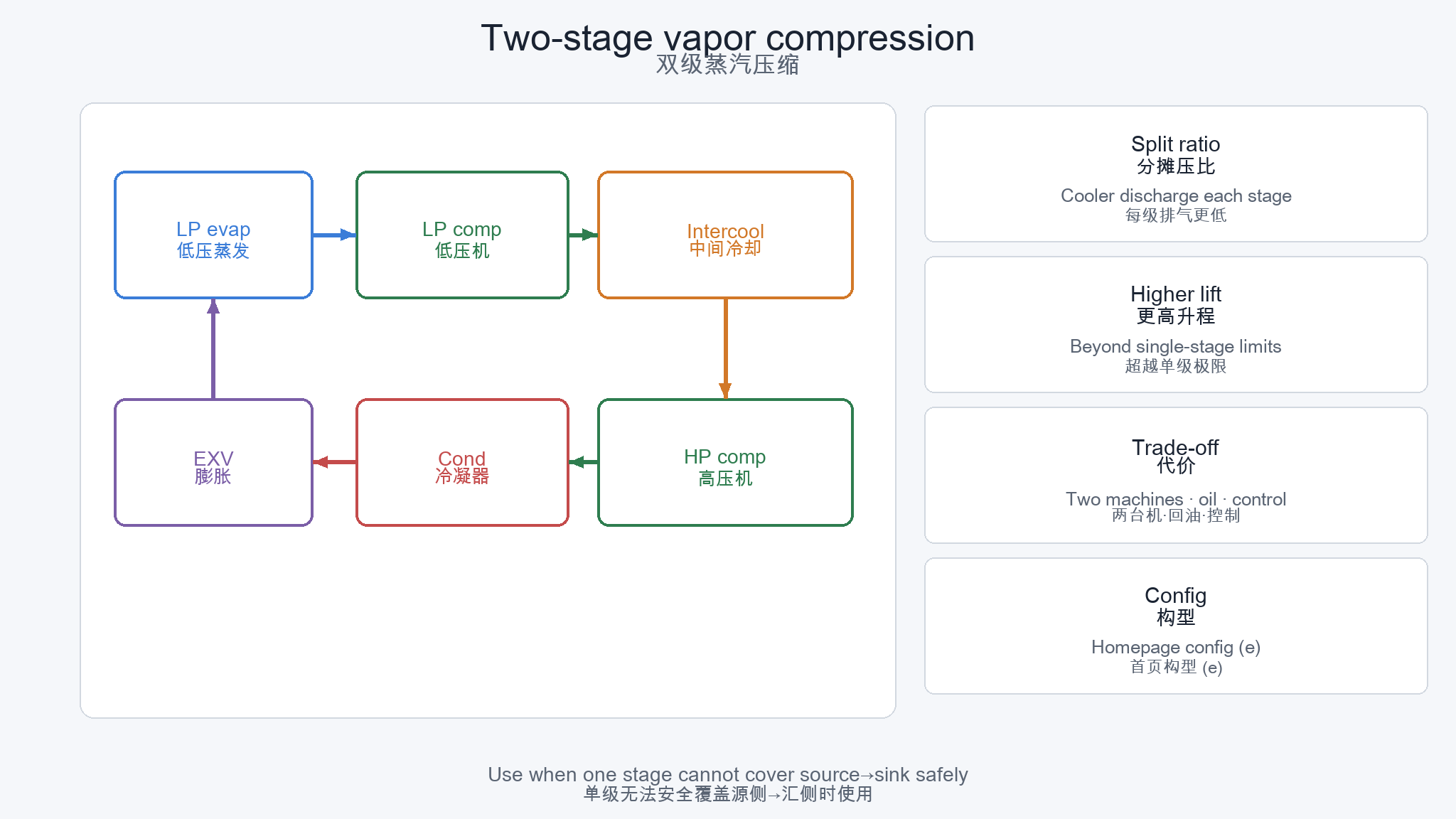
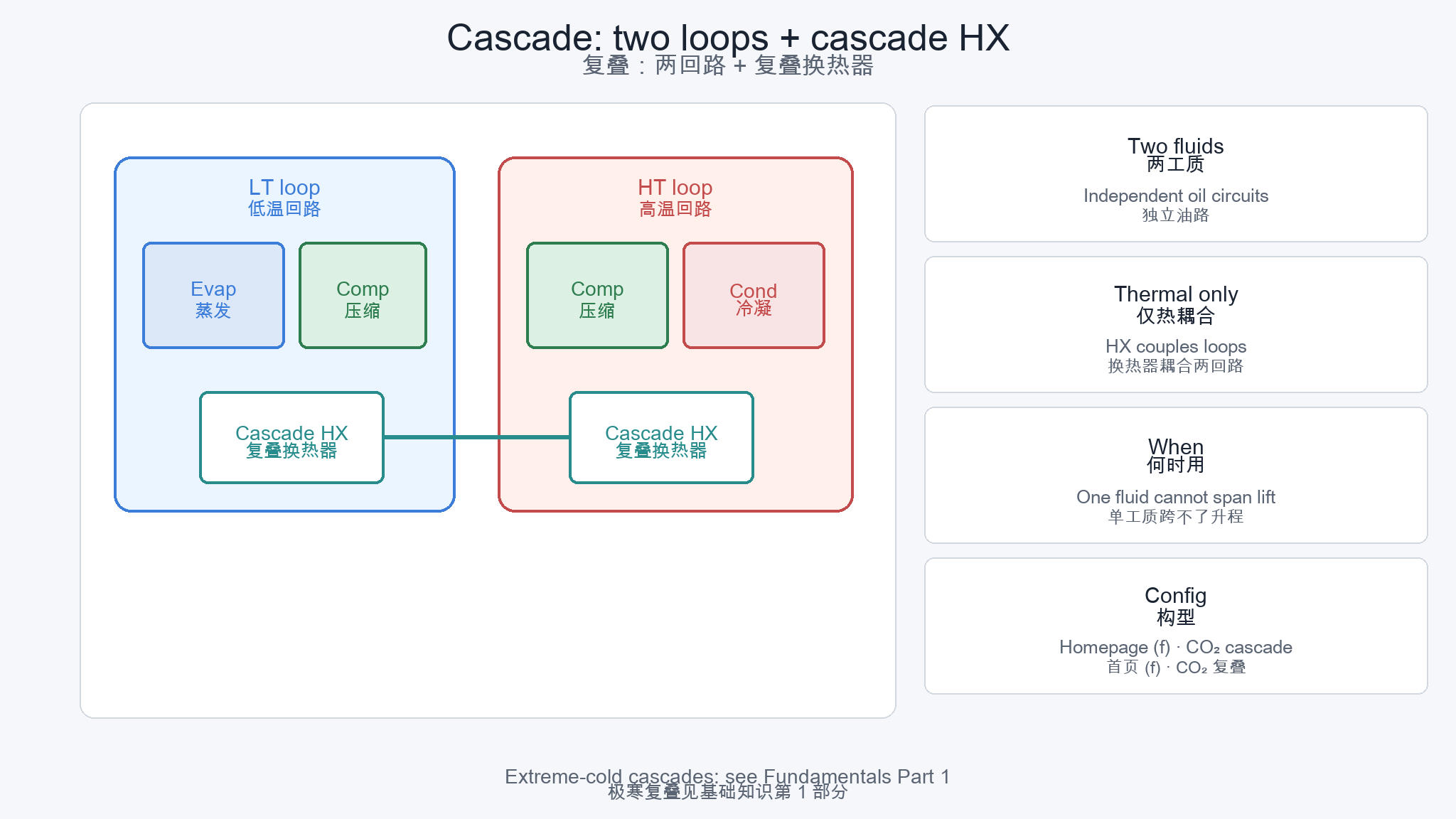
Same VCC physics, different staging. Names align with engineering toolbox so toolbox calculators and this guide share one vocabulary.
按痛點選強化
排氣溫度/中等溫升 → 經濟器或噴液/噴氣;單工質大溫升 → 雙級;單一工質跨不過熱源–熱匯 → 復疊。
噴射器 + IHX(配置 d)
用噴射器回收部分膨脹功並配合內換熱器——同屬 VCC 強化族。比方案時對照首頁配置 (d)。
代價不只是初投資
多一個容器/級就多泄漏點、油量、測點與調試小時。可靠性往往先於表格裏那一點 COP 差值定案。
5 · 跨臨界 CO₂——氣冷器,不是冷凝器
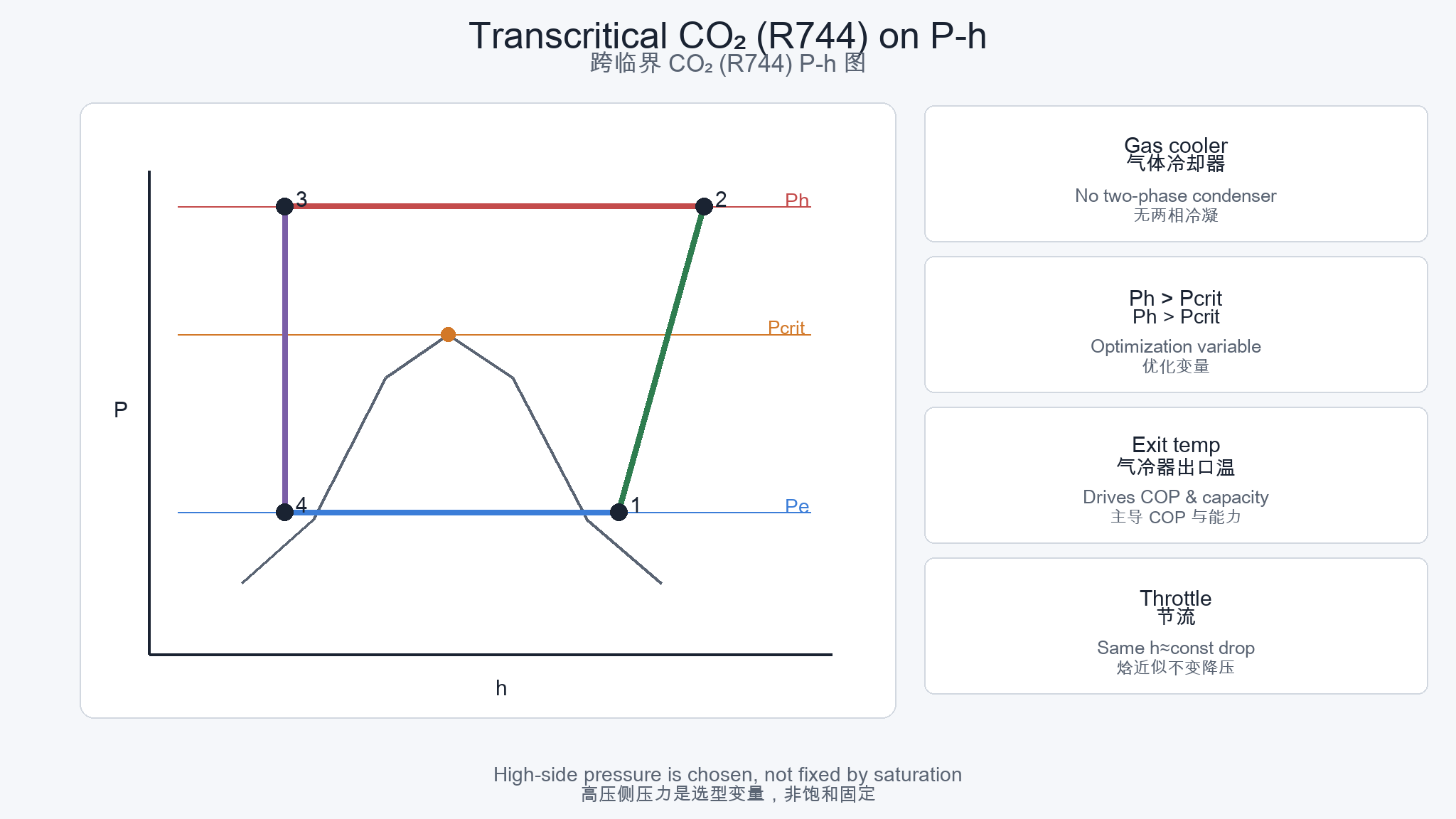
When high-side pressure sits above the critical pressure, there is no two-phase condensation. Heat rejection happens in a gas cooler; exit temperature—not a “condensing temperature”—sets much of the performance.
| Mode | 高壓側行爲 | 壓力量級(約) | 典型用途 |
|---|---|---|---|
| 亞臨界 CO₂ | 可出現兩相冷凝 | 仍高於多數 HFC | 有限溫區;常作復疊低溫級 |
| 跨臨界 CO₂ | 氣冷器 · 無冷凝 | 常見約 80–120+ bar 級 | 熱水、商用機組、部分熱泵 |
| CO₂ 復疊(極寒) | 低溫 CO₂ + 高溫工質迴路 | 低溫級高;高溫級隨工質 | 極寒供熱 — 第 1 講 |
用語陷阱
Do not write “condensing temperature” into a transcritical duty sheet. Specify gas-cooler pressure and exit temperature (and sink inlet).
Control & maps
Optimal high pressure moves with gas-cooler exit temperature. OEM maps and controllers matter as much as heat-exchanger catalogues—see heat-exchanger guide (gas cooler vs condenser).
工質語境
R744 selection, safety, and policy context: refrigerant guide. Standards pointer: GB/T 29707-class transcritical CO₂ heat-pump water heaters on 工具與標準.
6 · 吸收式——熱驅動的「熱壓縮機」
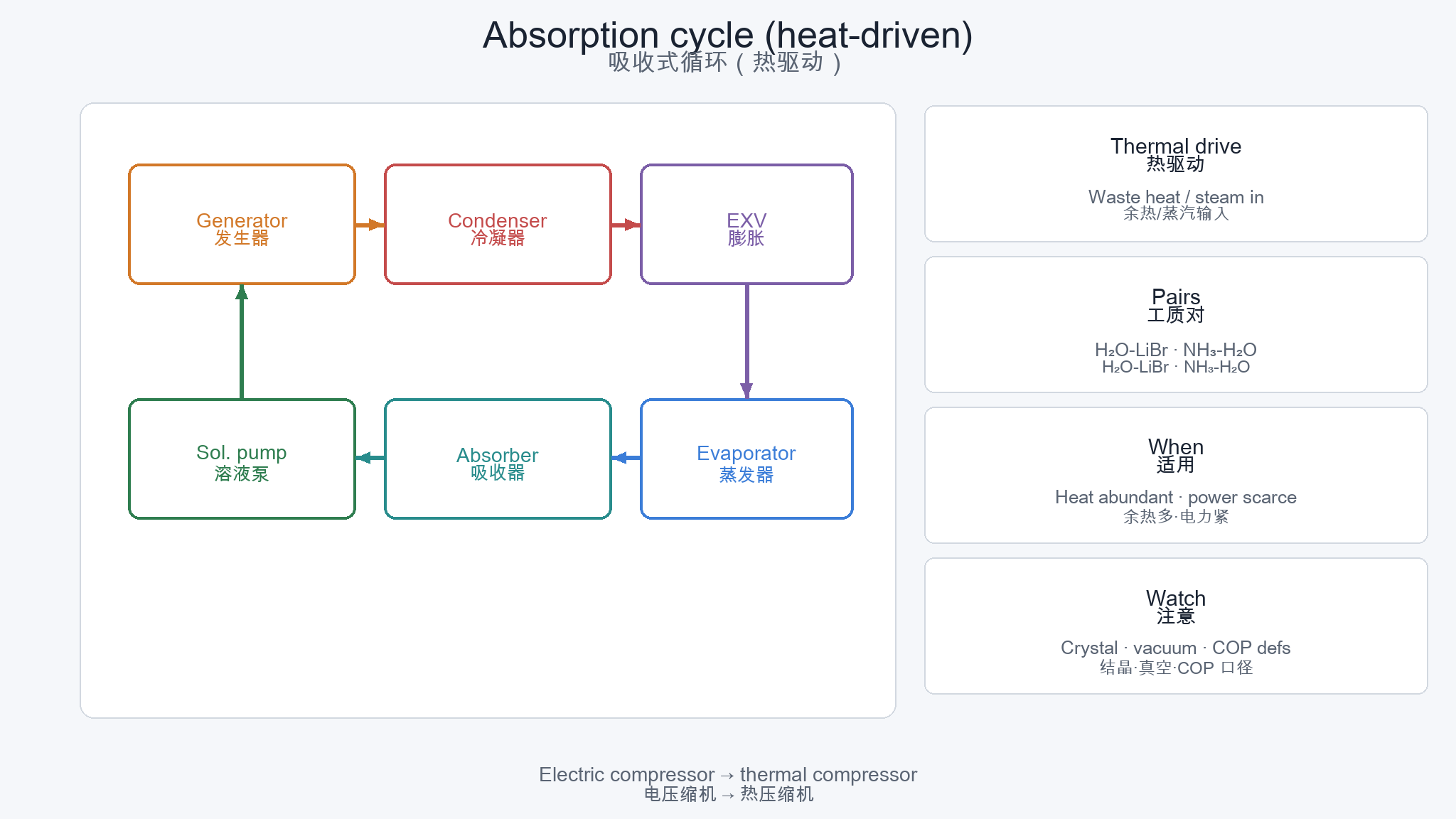
Absorption replaces the electric vapor compressor with a solution loop: generator (heat in) → condenser → evaporator → absorber → solution pump. Small pump work, large heat input.
何時更合適
餘熱/蒸汽充裕、電力稀缺或昂貴,或更希望熱耦合而非大電力需求的現場。
Boundaries
Crystallization (LiBr), vacuum integrity, corrosion, and maintenance culture. Not a drop-in substitute for a screw chiller without process and O&M review.
混合路線
IIR-style roadmaps also cite absorption–compression hybrids—see Industrial HTHP column and standards notes.
7 · 開式蒸汽壓縮 / MVR
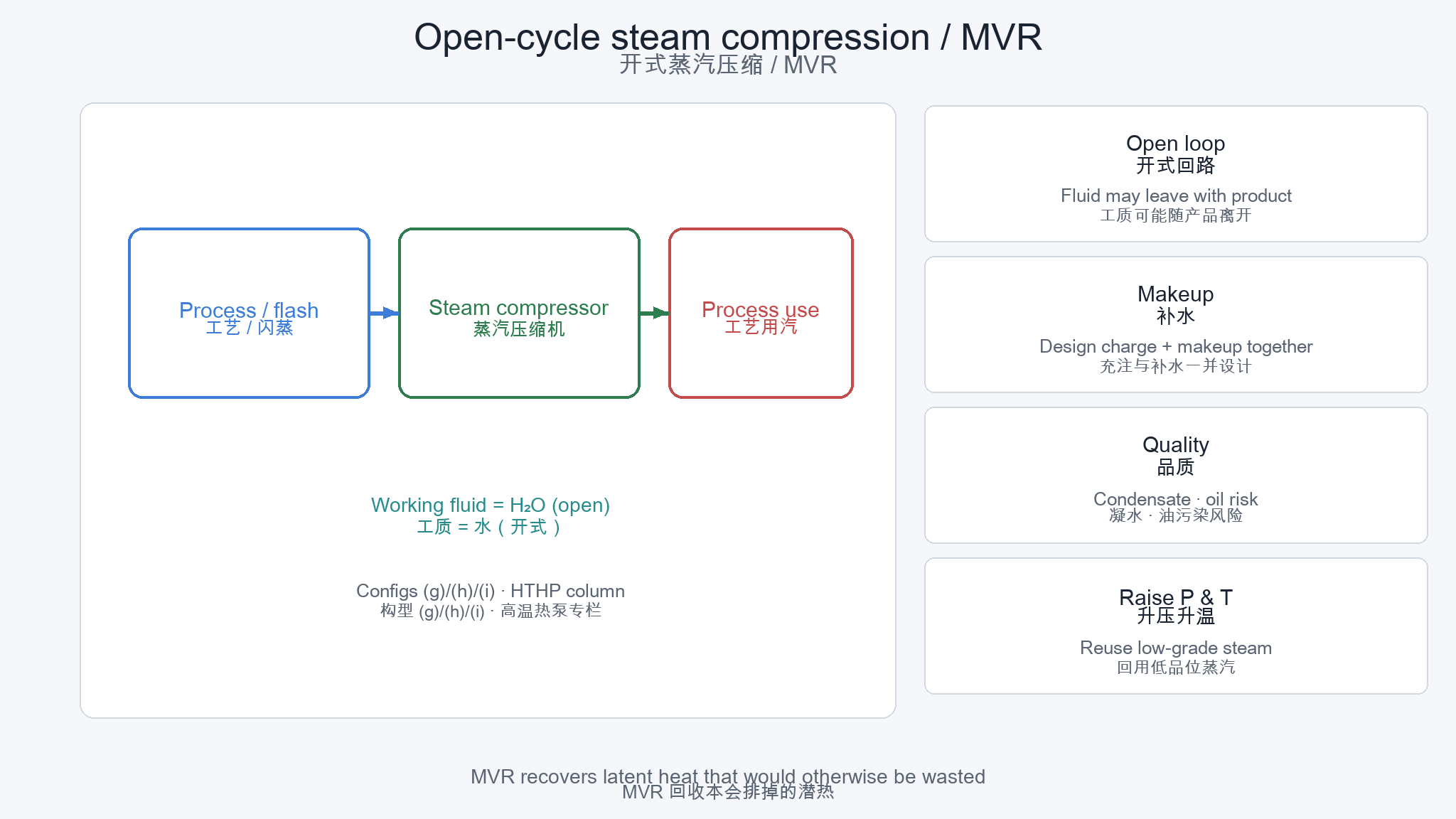
Here the working fluid is water vapor. A steam compressor (or MVR package) raises flash or process steam pressure for reuse—central to boiler-displacement narratives.
≠ 閉式增壓熱泵
MVR compresses process / flash steam in an open loop. A closed booster heat pump lifts reject heat with a separate refrigerant circuit—do not mix the names. See also 閉式 HTHP vs 蒸汽/MVR and Project Center recovery topologies.
開式迴路含義
蒸汽可能隨產品離開系統。補水、疏水回收與污染(含油)須與壓縮機組一併設計。
Steam quality & turndown
工藝關心幹度、壓力穩定與部分負荷小時數——不只峯值 COP。熱泵段須與蒸汽母管及控制耦合。
復疊 + 閃發變體
配置 (h)/(i) 把復疊與閃發或開式蒸汽結合——當單一開式迴路無法同時照顧熱源回收與蒸汽級熱匯時使用。
8 · Selection map — ΔT & duty → cycle family
從溫升與熱匯形態出發,再落到工質與現場約束。下表是初篩,不能替代 OEM 性能圖或工藝仿真。
| 溫升 / 情境 | 典型循環 | 工質提示 | 本站入口 |
|---|---|---|---|
| 小 ΔT | 單級 VCC | 多數 HFC/HFO/HC;氨 | 配置 (a) · 壓縮機導讀 |
| 中 ΔT / 排氣溫度喫緊 | 經濟器 / IHX / 補氣噴液 | 按壓縮機性能圖 | 配置 (b)–(d) |
| 大 ΔT、傾向單工質 | 雙級 VCC | 工業螺桿常見 | 配置 (e) |
| 跨度極大 / 極寒 | 復疊 | 常爲 CO₂ 低溫級 + 高溫工質 | 配置 (f) · 第 1 講 CO₂ |
| R744 高壓側熱水 | 跨臨界 CO₂ | R744 氣冷器 | 第 5 章 · 製冷劑 |
| 餘熱多、電力緊 | 吸收式(±混合) | H₂O–LiBr / NH₃–H₂O | 第 6 章 · HTHP 專欄 |
| 蒸汽級熱匯 | 開式蒸汽 / MVR / 閃發復疊 | R718 / 水蒸氣 | 配置 (g)–(i) · HTHP |
比價前務必鎖定熱源/熱匯溫度、工質安全等級與合同 kW 定義。逆布雷頓氣體循環仍是小衆例外,不是工業熱泵默認路徑。
Next: pick hardware with the 壓縮機, 換熱器, and 製冷劑 guides—or jump to engineering tools.
常見問題
「逆卡諾是可以採購的產品嗎?」
不是。它是理論極限。真實機組是 VCC、布雷頓、吸收式等,在相同 Tc/Th 下 COP 必低於該上限。
「製冷循環和熱泵循環是兩套機器嗎?」
常常是同一迴路,只是有用側記賬與 Te/Tc 不同。工業熱泵通常熱匯溫度更高——即便仍叫「蒸汽壓縮」,性能圖與分級也會變。
「跨臨界和超臨界是一回事嗎?」
In plant talk, “transcritical CO₂” usually means the high side is above critical pressure with a gas cooler. “Supercritical” is used more loosely in R&D; ask for Ph, gas-cooler exit T, and whether condensation exists.
「爲何不總用逆布雷頓——反正無相變更簡單?」
無潛熱意味着同樣 kW 需要更大流量與換熱器。除非特種氣體工況逼迫,工業熱泵幾乎總是優先有相變的 VCC。
「選定循環族之後去哪?」
Fluid: refrigerant guide. Machines: compressor / HX / valves / vessels guides. Industrial steam narrative: 高溫熱泵專欄. Config calculators: engineering toolbox.
示意圖與 COP 公式僅供工程導讀——不能替代設計計算、OEM 性能圖或安全規範。工質、壓力與運行包絡須以合格設計與型式試驗數據爲準。